Ledgerbound Review
Unapologetically Horny
One thing that is under-examined in the fantasy genre is the business opportunities behind heroing. Enter OmniMegaSuperCorp’s Ledgerbound and its chosen business of insurance. Offering a lighthearted, and incredibly horny, take on the desperate choices one can make when faced with corporate ruin, plus some convenient happenstance, the game provides a highly enjoyable fantasy romp aided by solid tactical gameplay. It may be a bit niche in its appeal, but those within that niche should find plenty to lap up here.
Ledgerbound follows Rayna, a woman living the fantasy corporate dream as a claims adjuster for the Heroes Unite Life Group, which offers insurance packages for the Queendom’s numerous hero groups. Rayna’s role is to help the company deny payouts by proving negligence on the part of any defeated heroes. However, her position and the future of the company are under threat when the Regulators, the Queendom’s most powerful heroes and under the company’s most comprehensive coverage, are defeated by otherworldly invaders called the Vacari. After investigating the scene of the incident, Rayna becomes imbued with a powerful relic and learns of a prophecy that might defeat the invaders. She and her expanding oddball collection of allies register as heroes and set out to fulfill said prophecy, thus proving the Regulators to be negligent and saving the company in the process.

Do what you love.
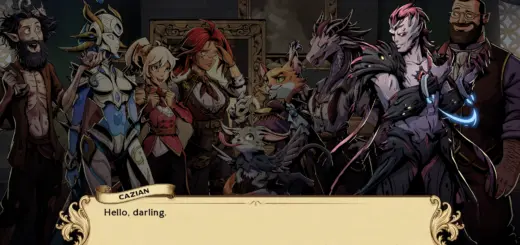
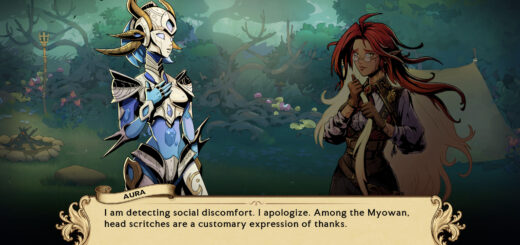
The rule of funny largely rules the day on the narrative, and it makes for a very entertaining adventure. The writing very much skews towards the mature side — exacerbated by a level of horniness that puts Baldur’s Gate III to shame — with murder, swearing, and innuendo aplenty. Fortunately, for most anyway, the mature elements are fully handled within the audio and narration rather than with any graphic visuals. The party itself is a motley crew of all sorts of beings; Rayna is very much a reluctant hero with her own bizarre quirks, with her best friend being the office hat rack that she ends up summoning as a weapon, while other allies include a magical robot, a feline prince, and someone who might be best described as a walking nightmare. The group is a disaster waiting to happen, but the game does a stellar job of establishing each character’s personal motivations and the backgrounds behind their individual quirks. Ledgerbound’s writing excellently skirts between humour and character-driven storytelling, ensuring that its characters get a ton of development across the course of the game as their bonds develop.
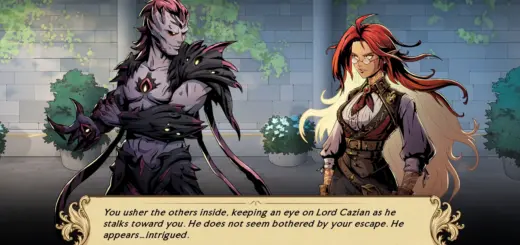
Ledgerbound’s humour and storytelling are aided greatly by the audio; the music is enjoyable, but the true star of the audio is the voice cast. The voice acting is excellent throughout and really brings the characters to life, with the cast working alongside the writing to produce a properly memorable set of eccentric characters. Stephanie Kerbis’s Jazz is a personal favourite, but other highlights include Cherami Leigh’s skittish Sylvie, Matt Mercer’s pompous Avarice, Ben Starr’s sultry Cazian, and more, with everything expertly narrated by Jeff Leach. The character designs also work incredibly well to make the characters stick in the memory and put the faces and voices together. However, location and battle visuals are less interesting to behold. There’s little to necessarily complain about, and everything is adequately conveyed without issue by the narration, but the backgrounds are very forgettable, and there’s not a whole lot of flair to the combat.

The game is not horny 100% of the time, but it’s not far off.
The game’s grid-based tactical combat is built on a similar template to Fire Emblem. However, rather than being based on weapon types, the effectiveness triangle is based on elements, with each combatant being fire, water, or earth. Each side’s fighters can act in any order, being able to move before using an attack or skill. Different characters can use melee or ranged abilities — based on strength or magic, which determines whether they act against armour or resistance attributes — and, provided they survive the hit and are within range, regular attacks are immediately countered by the opponent.
Between battles and their associated story events, players are given the opportunity for a “Resterlude” (an in-game portmanteau of “rest” and “interlude”). This gives Rayna an hour to spend bonding with her allies, including romantic endeavours of varying degrees of horniness. All party members, and HR colleague Jazz, can be romanced; two of the male love interests are monogamous and must be the only one romanced in that playthrough, but otherwise any number of the remaining polygamous allies can be romanced. Resterludes are also when players can adjust character equipment. Each party member has four slots for company swag, which provide a mixture of guaranteed and conditional attribute boosts. Characters also have slots for “liabilities”, additional equipable items and concepts that grant new active abilities or passive bonuses based on an insurable limit. Equipping new swag or liabilities also uses up a bit of Resterlude time, so players will want to consider choices carefully and not chop and change very often.
Players do not need to worry about recruitment or choosing which units to bring, with the full party always deployed into combat. The game provides a good variety of combat scenarios for players, mixing up objectives and scenarios decently without throwing out any unfair surprises that require massive reconsiderations on strategy. In addition to its victory conditions, each combat also comes with three optional side objectives that provide a bit more of an impetus for challenge. Completing these objectives awards tickets that can be exchanged for randomly-drawn company swag, and completing all three objectives also helps increase shareholder value, giving Rayna opportunities to bond with one of her corporate overlords. Players can replay any previous battle in the story, framed as Rayna using tabletop tokens as she does with her office insurance claims, in order to achieve those bonus objectives, though doing so uses up a small bit of Resterlude time.

Combat is built on the Fire Emblem template, though with an elemental triangle rather than a weapon one.
Players have three difficulty levels that can be switched between before and after battle; if players fail a battle, they can replay it and elect to lower the difficulty, though it will also cost bonding time. Like Fire Emblem, party members only gain experience when they use abilities and attack foes, though with the smaller and always active party, it’s a lot easier to keep everyone involved and sufficiently levelled. The game can be completed in around twenty hours, and its gameplay holds up strongly throughout that period. Combat is on the whole very satisfying, particularly when players manage to pull off all side objectives on the first try, and the fun writing and characters ensure that the narrative reward is well worth any trouble.
It is worth noting that the pre-release review build included some technical issues, including a few placeholder events, missing voice-overs, and freezes. Updates have been frequent prior to release that have filled in content and fixed issues, but it would not be surprising if some players were to encounter hiccups. Unfortunately, possible issues can be exacerbated by an overly aggressive autosave system. The idea behind it is understandable, but in practice the game gains very little from its prevention of save-scumming, and ends up permitting certain potential issues to cause more damage than they would’ve done otherwise.
Ledgerbound decides early on what it is setting out to do and as a result it does it very well. Even the technical issues of the pre-release build fail to take out the fully enjoyable nature of the game. In the end, it offers plenty of entertaining moments, aided by a fun set of characters and the excellent performances of its cast, wrapping them up alongside strong and satisfying tactical gameplay to keep players fully engaged.
Disclosure: This review is based on a free copy of the game provided by the publisher.


Entertaining cast and writing
Great voice acting
Solid Fire Emblem-esque gameplay loop
Technical issues in pre-release review build, compounded by overly aggressive autosave
Gameplay visuals lack flair




Recent Comments