Fire Emblem: Fortune’s Weave Review
A Fortunate Outcome
I was first made aware of Fire Emblem when my grandfather happened to introduce me to Path of Radiance back in the day, before falling deeply in love with Awakening on the 3DS. Seeing the series’ arc after moving back to console with Fire Emblem: Three Houses has been interesting to say the least. Three Houses brought a lot of innovations to the series, such as a Persona-esque calendar system and a greater emphasis on unit customization, while Engage felt like a back-to-basics celebration of the series. In this context, Fire Emblem: Fortune’s Weave feels like the best of both worlds while also improving on so many of the elements introduced in Three Houses that it’s genuinely staggering.
The narrative setup for Fortune’s Weave is a bit hard to follow at first. The game takes place in the continent of Dagda, south of the continent of Fódlan that was the setting for Three Houses. After the Demon God Balor has awoken and brought with him the apocalypse, the Goddess Sothis calls upon the player character, canonically known as Eshmel, to awaken and turn the tide in humanity’s favor. To do so, the Goddess of Fate, Fortuna, tasks Eshmel with going back in time and ensuring four warriors from the past survive to the present day. Those four figures are Cai, Dietrich, Theodora, and Leda. This is where the player can choose which character’s story to follow. Each one centers around said character’s participation in the Heroic Games, a tournament that occurs in the Dagdan capital of Dagsion and will grant the winner a wish.

Cai’s story almost feels innocent and goofy compared to the others.
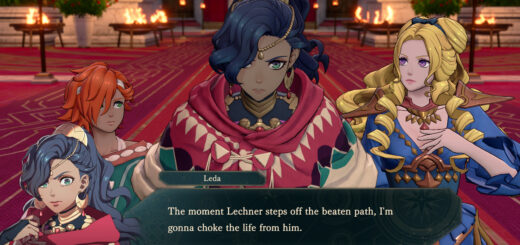
Although it’s a bit convoluted on paper and difficult to describe, once the story gets started and the player is introduced to the other main characters, the narrative becomes one of the game’s strongest elements. Each character has a different motivation for participating in the Heroic Games, and thus the tones of their stories are very different. Cai is positioned very early as just a kid from the sticks, and just wants to save his imprisoned father. His story has definite shades of shonen anime and is almost cheerful at times. On the other side of the coin is Leda, who is seeking revenge on her father’s killer. The contrast between Leda and Cai’s storylines is stark, with Leda’s being far darker and almost depressing at times.
Somewhere in the middle tonally is Theodora, the Queen of Saramis, a small country in southern Dagda that has been under the Dagdan Empire’s thumb for a long time, and so her story takes on an almost Game of Thrones quality as she navigates political situations while also learning how to be the best leader she can be. The standout story of the four, however, is Dietrich’s. The man wants exactly one thing: to fight stronger and stronger opponents, which is essentially his whole impetus for joining the Heroic Games. However, one of his companions, Fabio, has very strong connections to the larger lore that connects this game and Three Houses. This creates a very fun dynamic where Fabio basically uses Dietrich to go on a bunch of missions that anybody else would immediately be suspicious about, but Dietrich is more than willing because it means he gets to potentially fight some incredibly dangerous opponents. The interactions with Dietrich and his companions are nothing short of comedy gold that also manages to culminate in a surprisingly beautiful ending.

Dietrich hails from Fódlan, further tying this game’s lore to Three Houses.
While the story does an excellent job, the gameplay and systems of Fortune’s Weave are no slouch. The classic turn-based, grid-based strategy gameplay is at its absolute finest here, with a large variety of objectives and maps that present no small number of moments that will make players feel incredibly smart for pulling off that play or winning without sacrificing that one character. Map design and variety is also through the roof here, with some clever ideas that force players into using every unit at their disposal effectively, such as requiring one enemy to be killed before the true objective can be reached or certain items to be picked up that neutralize the negative effects of standing on hazardous tiles. The character customization systems are also fairly strong, though not as free-form as they were in Three Houses. Most characters have a few skills that they specialize in, so building into those rather than trying to build into something they are deficient in will be more rewarding, especially since opportunities to train in certain skills are fewer than others.
Rounding out the game’s achievements is the way it improves on Three Houses’ calendar system by integrating it with the world maps of previous entries. Before each major story battle, the player is given a certain number of turns. While doing things like training skills at the arena, eating meals and otherwise spending time with allies in Dagsion won’t use up a turn; what will is going out into the world map and exploring. The continent of Dagda is absolutely massive, and the sheer amount of places to go and things to see can be a little overwhelming at first glance. Most actions on the world map involves collecting materials, seeking out new items and weapon upgrades, or defeating enemies, many of which are necessary for completing side quests. However, each character has a unique way of interacting with the map. For instance, Theodora can go to different towns and recruit battalions that can then be assigned to different characters, giving them access to special abilities; meanwhile Dietrich can use his special ability to seek out hidden opponents on the map and fight them for extra experience.

Dungeons are filled with materials and treasure chests with useful items and weapons.
Furthermore, Fortune’s Weave reintroduces dungeon crawling to the series. It’s not especially thought provoking or interesting, but it does come with a different combat system for when the player runs into an enemy in the dungeon. In these instances, the game does away with the grid in favor of a traditional turn-based combat system. Instead of each character having an individual health bar, the party’s health is pooled, and the same is true for the enemy. These battles are incredibly easy unless the player is fighting significantly higher-level enemies, so as long as players are paying attention to their health, this combat system is more of a good way to get experience points and otherwise break up the pace of the game than a particularly deep or interesting system in its own right.
Completing each character’s path unlocks their ability to participate in parts two and three of the game in a story arc that zooms out and focuses more on the events that lead up to Balor’s revival and Eshmel’s battle against him. Thankfully, while these parts of the story are narratively far simpler and closer to the classic Fire Emblem story convention of heroes setting out to slay the dragon, the conclusion it draws is more than satisfying and feels like a true culmination of everything the player has been through. The game amply rewards players doing as many characters’ paths as possible before tackling the later parts, not only so that the map can be fully explored and available but also so that enough characters can be brought forward for the larger maps and objectives awaiting the player in the later chapters.
Despite its successes, there is a bit of a nagging issue that can be felt throughout the game. Namely, it’s clear that the overall story was built around not four paths but eight. Without spoiling who the other four potential main characters are, the game highlights several characters as incredibly important to the story, whose viewpoint would clearly provide even more context for what’s happening across the continent. These elements don’t severely hamstring the story or even really bring down the game; if anything one shudders to think what eight paths would even look like, as four already almost feels like too much. But it is apparent while playing that the developers had their ambition tempered a little too late in development, and as such, there are some characters that are clearly incredibly important to the story that just don’t get the screen time they needed.

Dietrich fighting one of the characters that suffers the most from obvious narrative cuts. At least the fight in the cutscene is cool?
Meanwhile, the presentational elements of Fortune’s Weave are all top-notch. Fire Emblem has never gone out of its way to push graphical boundaries, but this is by far the best-looking of the recent console entries. Every character model is distinctive and meshes quite nicely with the dialogue portraits. Said portraits can also have some brief animations when characters are expressing certain emotions, which is a nice touch. Both pre-rendered and in-engine cutscenes look gorgeous, with some impressive fight choreography and stunning moments. The soundtrack is equally amazing. Each main character has a unique musical style to them, such as Cai leaning heavily on a flute and Dietrich having some metal elements. These tracks elevate so many moments of the game both in and out of gameplay and easily stand next to the best the series has to offer. Furthermore, the English dub is great across the board, with special shoutout to Zeno Robinson and Xander Mobus for their performances as Cai and Dietrich respectively.
Ultimately, Fire Emblem: Fortune’s Weave is an absolute winner. Despite some clear evidence that somehow even more than what is currently in the game was planned, the game still feels complete, and the story is more than satisfying. The gameplay is some of the most refined it’s ever been, and the visuals are a massive step up from its predecessors, and the incredible soundtrack elevates the game even further.

Fun interconnecting story with well realized themes and distinct tones
Vast wealth of content
Traditional strategy gameplay in top form
Incredible soundtrack
Story suffers from obvious cuts
The game's scope can be overwhelming



Recent Comments