Adventure Corner ~ Forever Ago
Welcome to Adventure Corner, a column where members of the RPGamer staff can give their thoughts, impressions, and pseudo-reviews for various adventure titles that don’t fall under our usual coverage. Adventure Corner is aimed at delivering opinions on a wide range of titles, including visual novels, point-and-click adventures, investigative mysteries, and so forth.
In this edition of the column, we take a look at Forever Ago, an emotionally moving adventure game about love, loss, and grief.

Forever Ago
The people we love and choose to spend our lives with often shape who we become, leaving indelible marks on our identity and mental well-being. Forever Ago is a bittersweet, brief glimpse into a life touched by deep love, presenting a tale that shows both the best of love and companionship and the worst impacts of heartbreak when that love is ripped away. Through a very well-executed presentation, Forever Ago effectively communicates a deeply emotional tale of redemption, deploying some interesting twists and thought-provoking plot threads along the way.
Forever Ago opens with Alfred, an elderly man, stopping at Karl’s Pump ‘n’ Mart and preparing for a road trip across the American Pacific Coast. The gas station, owned by a friend from his youth, is no longer staffed solely by Karl; instead, an insistent, overly enthusiastic young man named Milton is on duty. In the store, Alfred is quite grouchy, reacting crassly to Milton’s upselling and chitter-chatter. Players quickly learn this is not without good reason: Alfred has recently lost the love of his life, his wife, Audrey, which has caused him to become reclusive and bitter. Alfred lashes out at Milton, demanding that he give him an old picture of Audrey, Karl, and himself hanging on the gas station wall, before huffing off in a daze.
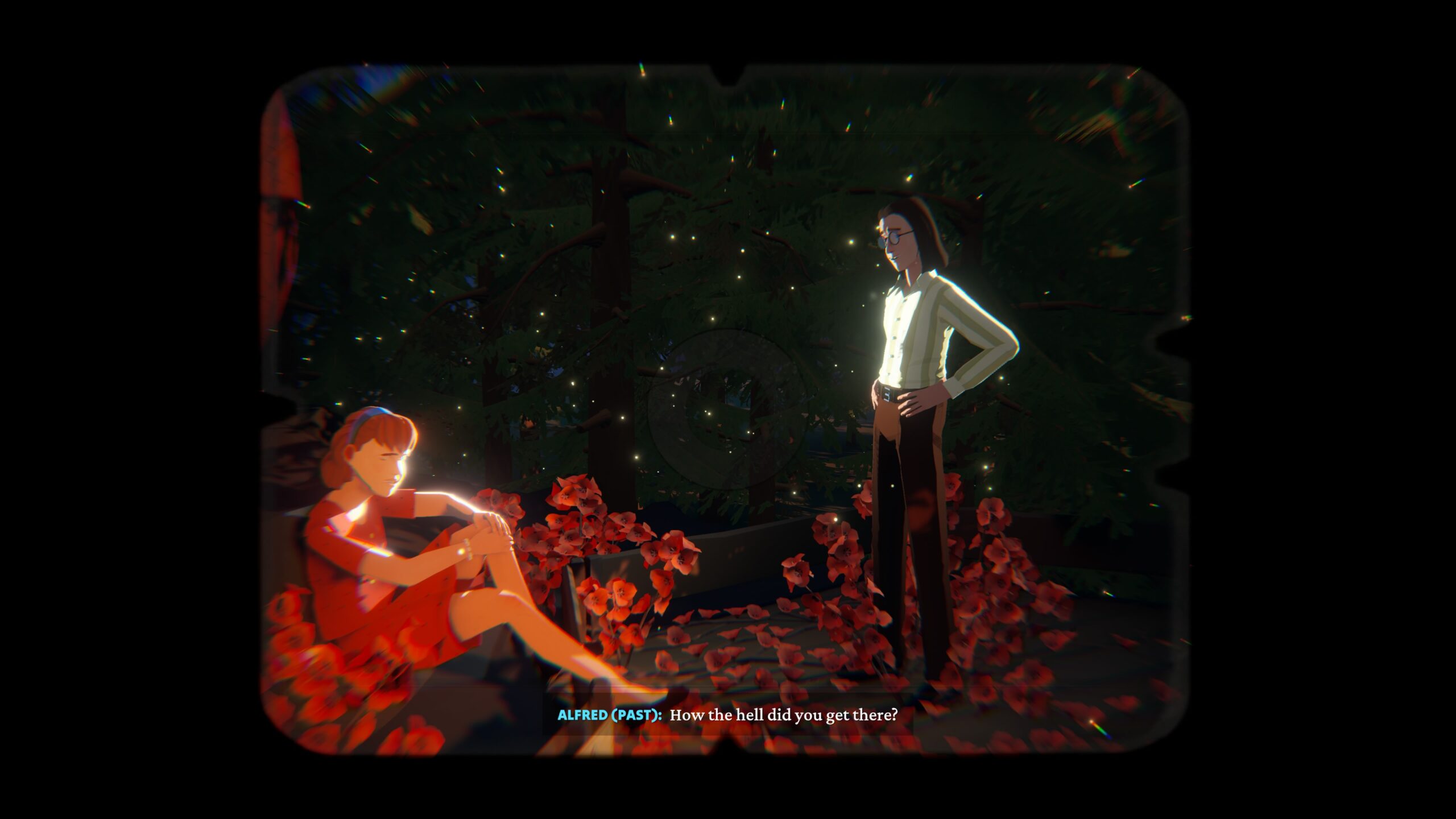
A young Alfred and Audrey in one of the game’s floral vignettes.
What makes Forever Ago’s plot quite remarkable is that it is told from the perspective of someone quite old. Alfred appears to be at least in his 60s, if not his early 70s, and it’s refreshing to see a viewpoint from someone in this age group. Alfred carries decades of emotional weight from his relationship with Audrey, which the game shows through flashbacks, as well as vignettes that can be triggered by finding red petals and taking pictures. Despite only spending a few hours with these characters, their relationship comes across as organic, touching, and beautiful, and it helps players sympathize with Alfred, even through his curmudgeonly behavior and occasional rude outbursts.
The impressive examination of Alfred and Audrey s relationship comes not only from the smart and emotional writing, but also from how thought-provoking its moments often are. Forever Ago often raises important questions about spontaneity, the fear of getting trapped in routine, and how relationships change us. This is not an especially long game, spanning about five hours at most, and its brevity largely works to its benefit. By offering brief snapshots of key moments in Alfred and Audrey’s relationship and not lingering on melodrama, Forever Ago delivers heavy, heartrending emotional moments while staying captivating within its short runtime.
Gameplay is simple adventure fare: each chapter has a level Alfred can explore, with a series of tasks in each location that he must complete, centered on key moments from his past relationship with Audrey. As an avid photographer with a journal Audrey gave him, Alfred can take pictures throughout the level and keep them in his journal at the end of each chapter. Nothing here is too complicated, and the game does a good job of having adequately sized areas that are interesting to explore but never confusing or daunting, which keeps the plot moving at a brisk, reasonable pace. While a few moments require players to fiddle with Alfred’s position to interact with an object, this happens only a handful of times and isn’t particularly intrusive.

Alfred travels across California’s stunning landscapes in his van.
Forever Ago excels in its presentation, with simple but colorful graphics that brilliantly detail the landscapes of the Pacific Coast and the fictional but believable set pieces Alfred visits. Beyond the environmental design, Alfred’s occasional mental flashbacks of grief are conveyed beautifully and hauntingly, with a spotlight shining down in a dark, fractured void. In this void, the shadowed set pieces are draped in vines of crimson-shaded desert mariposa lilies, Audrey’s favorite flower, and they stand out as some of the game’s most evocative moments. The game’s music features a good mix of relaxed, wistful, and even mournful tracks that effectively amplify its emotional conveyance, and the voice performances — particularly Piotr Michael as Alfred and Cissy Jones as Audrey — are excellent throughout.
Forever Ago is a thoroughly lovely tale, and by its closing chapters, I found myself crying quite a lot. Its themes are so devastatingly intense that, after the game’s gorgeous ending, I wasn’t quite ready to outline my thoughts until the next day. In just a handful of hours, it expresses itself with thoughtfulness, beauty, and nuance as Alfred journeys to seek redemption and solace. From beginning to end, Alfred grows compellingly, even through the heaviest loss, with plenty to convey about grief and love. Players who love brief but impactful narrative adventures will find Forever Ago a worthwhile experience.
Disclosure: This article is based on a free copy of the game provided by the publisher.







Recent Comments