Exploring New Worlds: RPGamer’s Favourite Settings, Part 1
One of the great things about RPGs is how they enable players to immerse themselves and explore brand new settings and locations. There is a huge variety of worlds for players to find themselves in, be it versions of real-world locations or truly bizarre and physically-impossible creations from the developers’ minds.
We invited the RPGamer staff to pick out some of their favourite settings from across the RPG universe and share what drew them into the world or made them particularly memorable. It should be noted that as revelations regarding the setting may be key for what makes them memorable, there may be some spoilers in the particular write-ups, though we have endeavoured to minimise them where possible. This feature will come in two parts, with the second part also available to check out. As always, we also invite our readers to share your favourite settings in the comments or on social media!
Baten Kaitos: Eternal Wings and the Lost Ocean — The Sky
The world of Baten Kaitos: Eternal Wings and the Lost Ocean goes unnamed in both the first game and its follow-up prequel Baten Kaitos Origins. Since the series moniker refers to the traditional name of a real-world binary star system, Baten Kaitos may well be a fitting name for its planet. Regardless, this world is a wondrous place as most of the livable land exists as floating continents and islands in the sky. According to myths and legends, these floating landmasses used to exist on the ground until a cataclysmic war with the wicked god Malpercio caused them to float up into the sky to escape the poisoned earth. Some scholars doubt this story and believe this world always existed as floating lands, but the most ancient written sources do state that they didn’t always float. In apparent response to life in the sky, most people have developed metaphysical wings of the heart that allow them to fly in short bursts. According to an NPC, people used to be able to fly between continents on their heart wings, but they’ve weakened over time and now they have to rely on vehicles instead. There are five main nations: Sadal Suud, Diadem, Anuenue, Mira, and Alfard. There are also smaller regions and rumored places, like a hidden frozen continent and the surface itself.
The Baten Kaitos games are beautiful, with lush and colorful animated prerendered backgrounds. All sorts of details, such as swaying leaves, moving clouds, flowing water, and even the designs of the NPCs and animals make the world really pop and feel alive. While the outfits of the player characters are the most distinct, as to be expected, even the NPCs wear colorful, and at times outlandish, clothes. Dungeons and towns alike are distinct and it’s very easy to tell where in the Baten Kaitos world the party is just by looking. Sadal Suud is arguably the most subdued out of the five nations, but its locations are still beautiful. The first major dungeon, the Moonguile Forest, is lush with vegetation and even the enemies stand out among typical RPG monsters, while still fitting the world of Baten Kaitos. Pherkad, the capital of Sadal Suud, has old buildings covered in plants and white clouds that hover low. Diadem is covered in pink clouds and is well known for its fishing villages and a celestial river that flows in the sky. Anuenue is a tropical land awash with vegetation, particularly flowers, whether in the dungeons or in the cities and towns. The Alfard Empire is known for its advanced, steampunk-looking technology but also for its rustic villages and desert.

Mira is easily the most fantastical of the five nations, and the strangest as well. This continent spends years at a time shifted into another dimension and is difficult to reach even when in the regular dimension. Because of that, there are many strange locations and the people have developed their own unique culture. There is Parnasse, a village made entirely of cake, candy, and other sweets with most of its inhabitants being bakers or confectioners of one sort or another. There is also Reverence, a village that looks like a child’s pop-up book and is populated by oddly-speaking robot-like beings. As for dungeons, there is Nekton, an eerie forest with bioluminescent trees said to be where the barrier between worlds is the thinnest. There is also Detourne, a garden where you can walk on the “ceiling” in some parts and there is a maze straight out of the Tower of Druaga arcade game. The capital city Balancoire is the most typical out of all of these places, but even it has an ethereal beauty to it.
The Baten Kaitos world really feels like paintings come to life, making these games stand out. Aside from the monsters, there are even unique animals such as prancers, which look like fanciful horses; pows, which seem to be a fusion between pigs and cows; and pollywhales, which resemble small whales with legs. Settings made up of floating landmasses may not be original to Baten Kaitos, but the games’ detailed locations and beautiful art style make it a memorable world that will stay with the player long after finishing the game. — Cassandra Ramos

Clair Obscur: Expedition 33 — Lumière and the Continent
Clair Obscur: Expedition 33 opens with a stark, emotional gut punch that frames the entire rest of the game: the Gommage. Each year in the island city of Lumière, which was fractured long ago from the main continent, its denizens fearfully gaze to the far north at the towering Monolith. An entity at the base of the Monolith, known as the Paintress, paints the Monolith with a number that decreases each year, indicating the next doomed age cohort, and subsequently erases everyone over a certain age. Gathering at Lumière’s shores, the citizenry fade into a mass of red petals, with a massive weight of grief blanketing the city as loved ones float as petals into the sky, never to be seen again.
This is the first pillar of what makes Clair Obscur’s setting so excellent: for all of known humanity in Lumière, the harbinger of doom remains firmly anchored to the north, the Monolith ominously towering above, and the Paintress annually bottlenecking humanity into extinction, all the while bringing widespread death and grief – the latter being the game’s most poignant theme. When the number counts down from 34 to 33 in the game’s opening, the despair and sorrow are palpable and intense.

With grief follows anger: a blinding hatred for the accursed Paintress who rests at the base of the Monolith, and a hope to slay her and end the Gommage once and for all. This is the mission of the Expeditioners, who set off a day after the Gommage each year into the unknown expanse of the continent beyond. They are the basis of the second pillar supporting Clair Obscur’s gorgeous setting. Rife with horrific monsters called Nevrons and the friendlier Gestral race, the continent operates under slightly different rules when it comes to the Gommage. Instead of fading into petals, the Expeditioners beyond turn to stone once their own Gommage approaches, with all color and life draining from their bodies. In every area of the continent, the stone corpses of thousands of Expeditioners spanning decades lay frozen in time, their final struggles, trials, and lives burned into the very geography. Expeditioners live by two creeds: “tomorrow comes,” and “for those who come after,” and everywhere players go, the sheer extent of the willpower and efforts to slay the Paintress are laid bare, as are the geographical alterations to make sure future Expeditions get a better chance. In this way, Clair Obscur richly weaves the wills, dreams, hopes, and struggles of the Lumièriens into the world.
It isn’t just the presence of previous doomed Expeditions that makes the Continent so emotionally impactful, though; it’s the sheer beauty, as well, which rounds out the third and final column of excellence. The Continent’s locations are colorful and varied, yet firmly united by a ruined, fractured Belle Époque-style world, with French culture and architecture abounding. It’s distinct and memorable, lending the game a novel identity against the wider RPG landscape. Clair Obscur, at every turn, evokes chiaroscuro masterfully, pitting light and shadow against each other in a brilliant dance. The life essence of the world, chroma, also flashes with brilliant color, with paintbrush-like strokes that give the Continent a vibrant look. Landscapes are simultaneously fear-inspiring and teardroppingly gorgeous, and it’s the visual flourish that ultimately rounds out this RPG’s breathtaking setting and the game as a whole. — Jordan McClain

Final Fantasy X — Spira
The world of Spira in Final Fantasy X is so remarkable because its very name is so thoroughly reflected and etched throughout the story, themes, world, and even gameplay. Spira, of course, is rooted in the word spiral: to twist or coil around. Spira’s world and populace are defined and scarred by so many cyclical processes; most importantly, a brutal cycle of death and rebirth.
Spiran society is trapped in a loop in which Sin, a giant whale-like monster, attacks and destroys large civilizations, devastating the land and preventing further civilizational growth. To counter this, various localities train a summoner to set off on a pilgrimage to defeat Sin. Every so often, they are successful, ushering in an era known as the “Calm.” But as reality has it, and as Yevon, the guiding religion of Spira, teaches, Sin always returns again and always will, for that is humanity’s punishment. This conflict is the crux of Final Fantasy X’s plot, as is putting a permanent end to Sin.

An early moment in the game sees Sin devastate a town, Kilika, and the destruction wrought afterwards lies scattered in the pattern of a spiral. And in one of the most beautiful moments in gaming history, the main summoner deuteragonist of the game, Yuna, performs a ritual in Kilika known as the “Sending.” With the dead resting in coffins below the water on the shore, Yuna walks on water, performing a dance with her rod where she spins and whirls, her rod tracing in spirals around her as she rises on a geyser of water. The dead’s souls, known in the game as pyreflies, orbit around her, spiraling into the sky to cross into the afterlife known as the Farplane. It’s a truly gorgeous, somber moment, and through Yuna’s spirals, Spira’s plight is starkly apparent.
Spirals and spheres are also present throughout the world and culture of Spira. Blitzball games take place in gigantic, spherical pools of water, and recording spheres are used to make visual or audio recordings. Architecture throughout Spira’s major cities are laden with spherical shapes or spiral motifs. The very physical makeup of Spira, being an archipelago of islands, is spiral-shaped, as are the paths and roads within it. Spirals even extend into the people, with the technologically proficient outcast race, the Al Bhed, having spiral-shaped pupils. Even the character progression system, the Sphere Grid, is in a spiral shape, and every character’s ability paths spiral into each other. Every part of Spira is cyclical, and it’s tough to think of a game that so thoroughly and beautifully fleshes out a core motif into its world as well as Final Fantasy X. — Jordan McClain

Fire Emblem: Three Houses — Fódlan
Fódlan is the continent upon which the games Fire Emblem: Three Houses and Fire Emblem Warriors: Three Hopes take place and consists of three nations: the Adrestian Empire, the Holy Kingdom of Faerghus and the Leicester Alliance. While Fódlan is a somewhat small continent, it has a rich history, expansive lore, and detailed cultures both found within its borders and outside of it. Even the setting’s calendar system and the story behind it is well detailed. While technically the characters travel all around Fódlan in Three Houses, because the game is a strategy RPG and thus has no real exploration, players can’t really get a feel for the various locations in a physical sense. Instead, Fódlan’s complexity is communicated through the story, support conversations, talking to NPCs, and reading in-game texts.
To make Fódlan’s long history short, the continent was first united under the Adrestian Empire. Around six hundred years later, the Holy Kingdom of Faerghus broke away, then one hundred and fifty-ish years after that, so did the Leicester Alliance. The continent has not only been wracked by rebellions and wars between the three nations, but also by invasions from other lands. In the center of Fódlan is neutral territory occupied by the Church of Seiros, which helps to mediate the three nations and maintain an at times unsteady peace. This history has profoundly shaped not only the story, but the characters as well. Adrestia is an empire with a rigid hierarchy. There is a great emphasis placed on nobles, with even many government leadership positions like the prime minister being passed down in the same families. This can be seen in the students from the Black Eagles house, as all but two of them are Adrestian nobles. In Faerghus, children are taught how to wield weapons at an early age due to the cold, harsh environment. The people also tend to be more pious to the Church because they helped Faerghus to win their independence from Adrestia. Notably, Adrestians, Edelgard in particular, are more cold to the church due to past occurrences. The Leicester Alliance is not a unified monarchy like the other nations, but a league of allied noble families led by House Riegan as a sort of first among equals. Leicester seems to have a strong merchant class, seen in the characters Raphael and Ignatz. The importance placed upon people with Crests can be seen throughout the continent, which has led to much strife and trauma for many characters. Two of the Officers Academy’s house leaders, Claude and Dimitri, want to reform the Crest system, while Edelgard wants to abolish it completely.

What curiously makes Fódlan stand out isn’t just the continent itself, but the many lands that surround it. This is especially noteworthy in the Fire Emblem series as most games only ever take place on one continent, with no mentions by name of other lands. The most prominent of these areas is the continent of Dagda, located across the ocean to the southwest of Fódlan. They invaded at some point in the recent past, with the playable character Shamir being a Dagdan mercenary who remained in Fódlan. Dagda is also set to be the setting of the upcoming Fire Emblem: Fortune’s Weave. There is also Brigid, a small archipelago where they speak a language not shared with the Fódlaners. Petra of the Black Eagles is its princess, and is being kept as a political prisoner due to Brigid being a vassal state of the empire. Almyra is a large nation located across a mountain range to the east of Fódlan that raids and gets into skirmishes with Leicester from time to time. The character Cyril is originally from Almyra, while Claude is half Almyran. There are other named regions that are less significant, but are still interesting to note, such as Sreng, Morfis, and Albinea.
Much more can be said about Fódlan and the rest of the world these games take place in. It is this complexity and attention to detail that makes Fódlan feel lived in and alive. The games really make it feel as though the setting shaped the characters and the characters shape the setting. It’s a small wonder that Intelligent Systems decided to return to this world again, after the Cindered Shadows DLC and Three Hopes action spin-off, even if Fortune’s Weave will take place on a previously named but unseen continent. The writers and developers really outdid themselves with Fódlan and the lands surrounding it. — Cassandra Ramos

Kingdom Hearts — The World
When I first heard about Kingdom Hearts in the early 2000s, a fantasy action-adventure RPG crossing over both Disney and Final Fantasy, I thought it sounded too good to be true. But how would that work? I couldn’t picture Cloud and Mickey Mouse in the same room, with an entirely original cast, and not have it feel like an awkward amalgamation of franchises. Having grown up as a Disney kid, and discovering Final Fantasy in my early adolescence, though, I had to see it for myself. I was definitely not disappointed. To this day, the universe of Kingdom Hearts (the World) remains one of my favourite RPG settings of all time.
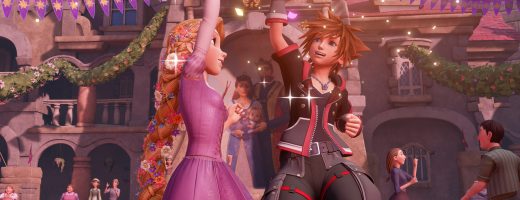
In Kingdom Hearts, the World is a hybrid between Disney-based and original locations across several realms. Most of the Disney worlds, and a handful of original worlds, exist in the Realm of Light and are traversed by the Gummi ship. Together with the other realms, they blend into a one-of-a-kind setting that is Kingdom Hearts. Today, there are over fifty worlds in the franchise, but the most memorable to me are the ones in Kingdom Hearts I, being the first game I played in the series. The worlds in this game include Neverland (Peter Pan), Wonderland (Alice in Wonderland), and Deep Jungle (Tarzan), to name a few. The original worlds, Destiny Islands, Traverse Town, and Hollow Bastion also became fast favourites.

What I love about the setting is that we get to live out what essentially feels like an alternate, video game reality of our favourite Disney tales. In the first Kingdom Hearts game, as Sora gets separated from his friends in his hometown of Destiny Islands, he stumbles across Disney worlds and becomes a part of their narratives by helping to resolve the main conflicts of each story. As the battle between Light and Darkness is a predominant theme in Kingdom Hearts, the black-and-white heroes and villains of Disney feel intuitively at home in the universe. They’re also given befitting lore. For instance, the Disney princesses are also Princesses of Heart, and the Disney villains succumb to the Darkness in their hearts. Additionally, with Final Fantasy characters spread across the original worlds in Kingdom Hearts, the diverse World takes on its own shape — there’s a certain charm about having Tidus, Wakka, and Selphie “canonically” grow up with Sora, Kairi, and Riku on Destiny Islands in this universe.
The worlds are fantastically woven and make for a varied setting where no two locations feel the same. Each Disney tale forms its own level and takes on a familiar art style, plot, and even voiceovers or score from the original intellectual properties, but reimagined to fit into the fantasy setting of Kingdom Hearts. In the first game, Sora transforms into a merman in Atlantica (The Little Mermaid), explores the belly of Monstro the whale (Pinocchio), wanders the chaotic streets of Agrabah (Aladdin), and is sucked into a story book for 100 Acre Wood (Winnie the Pooh). Add in the original locations with their own thoughtful designs, such as Hollow Bastion, and you’ve got a cohesive setting that feels nostalgic yet distinct. This approach to setting is carried on throughout the rest of the Kingdom Hearts series, and I have yet to come across a crossover that I’ve enjoyed this much. — Elena Ng

We hope that you’ve enjoyed reading about our first batch of favourite RPG settings. Be sure to check out part two, and let us know your favourites!





Recent Comments