Shrine’s Legacy Deep Look
Those looking to fill a SNES-era RPG hole in their hearts will certainly find something to enjoy here…
It is rare in the current year to see a game so obviously and unabashedly taking after the SNES era in terms of tone, visuals, and design, which makes Shrine’s Legacy a bit of an outlier among its indie peers. The game is very clearly a love letter to its inspirations, chief among them being Secret of Mana and The Legend of Zelda: A Link to the Past, and while there are certainly some rough edges, it is difficult to deny the work put in to honoring what came before.
Shrine’s Legacy tells the tale of Rio Shrine, who lives in the small town of Yuril on the continent of Ardemia. The Shrine family has passed down the Sword of Shrine from generation to generation, while the eight elemental Gems associated with it are scattered across the continent. Once the Sword is infused with the eight Gems, it will be complete and can destroy Aklor, a malevolent being who has been sealed away over and over again by the Sword of Shrine. Unfortunately for Rio, the other protagonist of the game, the mysterious mage Reima, arrives in Yuril after escaping with the Ice Gem. Aklor has arisen once again, so it is up to the two of them to gather the Gems and destroy him once and for all.
The narrative of Shrine’s Legacy is a mixed bag. Dialogue can be weak even in otherwise hard-hitting moments, characters can be fairly one-note and uninteresting, and the plotline feels like an underthought hodge-podge of ideas, leading to several twists that don’t feel satisfying, especially in the game’s third act. That said, Rio and Reima are fairly well fleshed out over the course of the main story, and the way they interact with even the most trope-filled, uninteresting characters can be fun. Aklor isn’t a particularly interesting villain, but he does a good job of establishing his presence early in the game and, for a villain of his archetype, is surprisingly active, showing up in person and having a direct impact on the narrative rather than simply sitting in his lair twirling a non-existent mustache. This gives the player much more direct motivation to destroy him than just doing so because the main characters say they need to.

The world map does a great job of showing each area’s personality.
The world of Ardemia is a highlight of the narrative. Every locale is distinct, and though some understandably rely a bit heavily on tropes — such as there being a big city where Ardemia’s royal palace is located, a port town, a reclusive village where a distinct race of people live, and more — others do an excellent job of bucking these trends. The dungeon where the primary gimmick is using electricity to progress takes place on a beach with stones jetting out of the ground emitting electricity. The beginning forest area also has stark red slime covering the area, leading to a nice color contrast. The soundtrack does a good job of accompanying the world, but nothing about it stands out as truly excellent.
Unfortunately, excellent visuals do not always translate to excellent gameplay, and this is where Shrine’s Legacy can be hit or miss, especially in combat. Rio and Reima have extremely similar move sets — a standard basic attack and a dash attack — both of which build MP, and can then be spent to use elemental magic. Later in the game, the player can learn a charge attack for both of them, but the use for this attack is incredibly situational, as charging is very slow and the attacks themselves don’t accomplish much that basic attacks can’t. Exploiting enemies’ elemental weaknesses is the primary method of doing damage, and Reima’s high magic stat makes her the best choice for bosses and enemies with larger health bars, while Rio’s high physical attack makes him a good choice for larger groups of small enemies, which encourages swapping between them if not playing in co-op.
As the game progresses and enemies do more and more damage, positioning will become increasingly important, which makes it extremely unfortunate that attacking and dodging feel so stiff. Post-attack delay is high, and chaining abilities requires timing actions out in ways that aren’t intuitive. This is especially weird, as enemies often don’t flinch or get pushed back by the basic attack, which locks players in place, but contact damage makes it risky to use a dash attack to close the distance and attack. While the game is almost never difficult enough to make these problems more than annoyances, there are certain enemies where these quirks are more pronounced in the late game, which can make for an awkward spike in difficulty.

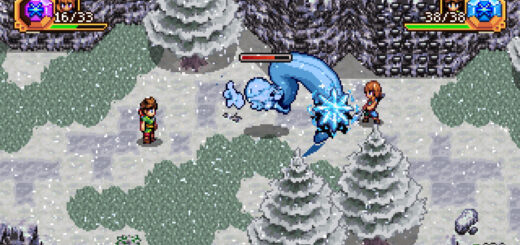
Frustrating boss mechanically, extremely cool visually.
Dungeons in Shrine’s Legacy are incredibly Zelda-esque in their design, with dungeon maps, keys, and rooms locked by combat encounters. Unfortunately, the execution of most dungeons leaves a lot to be desired. Puzzles are incredibly frictionless, which causes them to feel more tedious than interesting. Furthermore, the game has several odd instances of poorly explaining mechanics. The best example of this is the Wind Gem’s ability to generate pathways between otherwise disconnected surfaces. While the mechanic itself is introduced to the player before they obtain the ability to do this at will, at no point is the player given any indication that this is an ability that can be used outside of the already established context.
Ultimately, Shrine’s Legacy is a game brimming with passion and care that misses the mark on a few key elements. Those looking to fill a SNES-era RPG hole in their hearts will certainly find something to enjoy here, as the game carries the charm of that era in its narrative, visual design, and structure. While combat can be one-note and awkward at times, and the dungeons are incredibly basic in their design, none of these problems prevent the game from being a fun romp.
Disclosure: This article is based on a build/copy of the game provided by the publisher.



Recent Comments