STARDUST: Wish of Witch Review
Wishing For More
Developer Kniv Studio and publisher Sologame have an interesting product on their hands with STARDUST: Wish of Witch. On one hand, the game has some exceptional presentational qualities, a heartwarming narrative, and interesting combat ideas within the tactical genre. On the other hand, the narrative is a bit unfocused at times and a finicky UI along with some questionable design choices turn what could have been a fun system into a chore.
STARDUST begins with two teenagers, Star and Yu, who live in a small village near the larger commercial city of Tranya. Star is a rather chaotic and sometimes immature young girl with dreams of becoming an Adventurer, and she has the sword skills to do so. Yu is Star’s best friend, a young mage who is certainly more level-headed and mature, but is still a kid at heart. After saving a traveling merchant from some monsters and helping the Tranyan Adventurer’s Guild with a monster infestation, the two of them become effectively Interim Adventurers, beginning their journey. The relationship between these two is the heart of the game, and their journey to become true adventurers is, while predictable, still ultimately satisfying in the end.
What enhances the narrative is the presentation. The pixel art is astonishingly gorgeous, and the animations are top-notch across the board. Whether it be skill animations in combat or character’s facial animations during humorous and dramatic cutscenes, every character feels so alive and vibrant in this game which utilizes its visuals in a striking manner. The voice acting is another highlight, and while an English dub would have been nice, the Korean voice acting is truly excellent from protagonist to NPC. Every major cutscene is fully voiced, and most human characters and enemies have voice lines associated with them. Musically, while the soundtrack isn’t anything groundbreaking, every track does an excellent job of matching to the situation or the scene, especially further into the game’s narrative as the stakes increase.

Every character is incredibly expressive, even without a portrait during dialogue.
STARDUST: Wish of Witch’s narrative has an extremely large scope that doesn’t fit the intimacy of the protagonists that it follows. A lot of events occur offscreen and worldbuilding occurs that may only be tangentially relevant to what’s happening to the characters. With a longer runtime and more content, this would be fine, but with a 14-hour runtime, the narrative is pulled into far too many directions for so many events to be happening that aren’t relevant to the primary conflict. So much of this seems like setup for an eventual sequel, but it’s hard to be invested in the wide world when it takes away from a genuinely sweet narrative shared between Star and Yu.
Gameplay has some interesting ideas that unfortunately have more than a few stumbling blocks. Players will have access to a maximum of four characters, each of them with unique strengths and abilities. For instance, Star is a fast physical attacker, so her moves involve her crossing long distances and attacking enemies up close, while Yu is a mage that specializes in fire magic, dealing large amounts of damage or causing debuffs that make his fire attacks deal even more damage. Each character also has unique passive abilities that activate under certain conditions. For example, Yu’s innate abilities allow him to gain buffs both when he attacks and when he is attacked, effectively ramping his damage at all times. Unfortunately, not all innate abilities are created equal, making some characters far more powerful and easy to play than others, which leads to the game feeling wildly unbalanced and discourages experimentation.
At the start of combat, every character will have one mana, up to a maximum of five, which increases one per turn. Mana can be used to activate skills, which are each character’s bread and butter. Skills can be used to buff teammates, debuff enemies, or attack. Each skill is presented as a card, and each card will describe the skill and its effect in detail. Skills can be chained together into combos, provided the character has enough mana. These combos can be used to deal massive amounts of damage and are incredibly useful against high health enemies. The combo system is incredibly satisfying, but it often feels restrictive due to the limited resources and pulling off a big combo is exceedingly rare. The combo system is also balanced heavily by the counter system. Certain skills can be used to counter attacks, so if an enemy attacks a character that still has mana carried over from their turn, that character can use a counter skill to interrupt the enemy’s attack and deal damage in return.

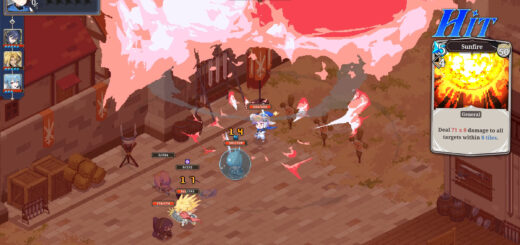
Characters have access to some amazing abilities that can mow down many targets at once.
While countering can be satisfying on the player’s side, one of the issues is that the counters that don’t count as an attack, usually in the form of a dodge roll or a teleport, can still be hit by the skill if the character ends up in the skill’s range, something which is not communicated to the player in the slightest. The rules feel inconsistent, and dependent of the skill that the enemy used rather than a blanket rule about dodging within an enemy’s attack range. Another issue is that enemies also have access to counters. This drags combat down as there are not any on-screen indicators that inform players that an enemy can counter. Instead, players have to dig for this information. Looking at every enemy’s information for their skills is immensely tedious, flow-breaking, and causes paranoia rather than strategic thinking due to the harsh penalties of having the party’s skills go on cooldowns and lose mana even in failed attempts.
These issues are compounded by a UI that is often actively working against the player. Playing on controller is highly discouraged, as the current implementation makes taking an action feel extremely sluggish and at times confusing. This is due to the fact that many actions, especially in combat, require several more inputs on controller than they do on mouse and keyboard, making every action take far longer than necessary. But even with mouse and keyboard, the combat UI is often unclear and can cause confusion. Combos are an excellent example of this; when players select an attack, they must choose who to attack or what direction to attack in. While this is being selected, other available skills are still highlighted green, including those able to be incorporated into a combo, which intuitively feels like an indication to select these skills. However, in order to chain attacks in an actual combo, players must first confirm their previous skill before combo cards will be highlighted in yellow and able to be confirmed. Those yellow cards can then be selected and confirmed. The lack of a good tutorial means this UI is confusing when first introduced.

Hitting multiple enemies with a massive attack is incredibly satisfying.
There is also a severe lack of variety in the mission design of the game, with only one story mission that doesn’t involve killing everything on the map, and that one is both extremely short, and a scripted event. The only variety is in the boss encounters, which have some fun aspects like focusing more on positioning and survivability rather than warding off a large amount of enemies. The only thing to do is fight and walk around an incredibly generic city with a few character progression vendors, such as the blacksmith who can make accessories to enhance stats and a shop where players can use money to purchase items to use in combat.
These issues take some interesting design ideas and make combat into a sluggish chore rather than a joy to play. The main campaign has the benefit of novelty, as there’s a decent enough variety of enemies and bosses to carry the story. However, the side content is simply recycled content from the main story. This itself is not an issue, but every main story mission is surmountable with minimal grinding required, especially if one is familiar enough with their characters and how to use them properly. This renders side content a difficult recommendation, as it is mostly a retread of gameplay that is already on shaky ground without any of the benefits of the story quests.
STARDUST: Wish of Witch succeeds with stellar details in its presentation and when the narrative focuses on the two protagonist. It fails in its slow gameplay pace, lack of mission variety, and confusing UI that turns it into a chore. These problems turn a charming tactical adventure into an incredibly difficult recommendation, as even the best animations can’t save a game from being a slog to play.
Disclosure: This review is based on a free copy of the game provided by the publisher.

Some interesting combat ideas
Heartwarming relationship between protagonists
Amazing pixel art and animation
UI makes everything unnecessarily confusing
No mission variety
Story strays into unncessary worldbuilding too frequently



Recent Comments