Montabi Review
And a Swish Swish Here, and a Swish Swish There…
Creature-collection games are a dime-a-dozen, and finding a new gimmick to breathe life into the genre can be quite challenging. Success requires coming up with creative creatures to collect and establishing a gameplay loop that can sustain itself for multiple hours, but also sufficiently strong execution and presentation. Mankibo’s Montabi blends creature collecting with a roguelite deckbuilder to craft a title with flexible gameplay, but is plagued by its lack of storytelling and game-breaking bugs.
The story of Montabi is a simple one: the trainer is tasked with rescuing their kidnapped Montabi by the evil X Gang. That’s it. It’s an effectively non-existent narrative that provides a simple goal for the player to complete. The game expects the player to complete the game with each of its three selectable trainers to see the bare-bones tale to the end, only to be given one of the most generic plot twists to grace a video game. Everything in terms of story is simple, boring, and adds zero depth to the game. Only a few typos exist in the game, but it’s impressive given how little of a story there is to begin with.
While there is little to no story to speak of, that is not why one plays Montabi. The game’s hook is in its creature-collection roguelite deckbuilding action, and it’s an addictive loop. The goal is to work through three different maps, with the trainer selecting different nodes on the screen, each with different elements to help beef up the player and their Montabi throughout their journey. Event nodes can offer players great boons or grave misfortune when landed on, while stepping on the Gatchapon and Vending Machine nodes will offer up randomized equipment for the journey ahead. Every playthrough feels different enough, with players hoping they can acquire gear that will make encounters easier. However, players can also obtain gear that can be detrimental during a run, but that is an accepted part of the game with randomized systems in roguelites.

Let’s battle… with cards!
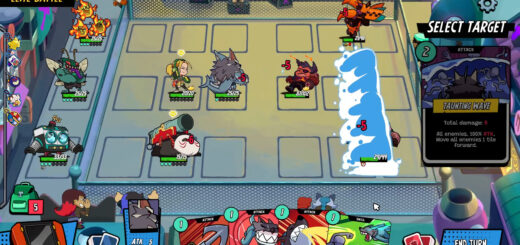
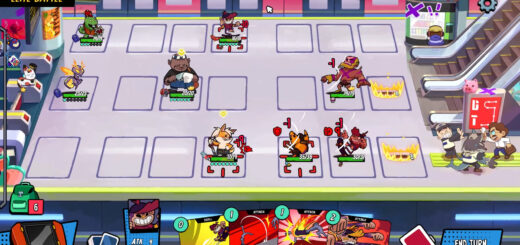
The game begins with selecting a trainer and one of three starting Montabi. The three Montabi offered are completely randomized, meaning every playthrough offers new choices to start the game. Players will move around the map and encounter others. Battles take place on a 3 x 3 grid, with players joined up to two Montabi at once. In battle, each character has a deck of cards, which can include buffs for allies, debuffs for enemies, armour cards, and straight attack cards. Characters start with three Attack Points (AP), with the number in the top-left corner of each card corresponding to how much AP it consumes. Some cards provide smaller shortcut cards costing zero AP, and taking advantage of those is critical to success in battle, especially in the late game. There is so much strategy that comes into play, as cards are randomized every turn, and as the run progresses, players can also obtain Legendary cards that can be game-changers in boss battles, including more powerful armor buffs and attack boosts. Battles are randomized chaos, making every run unique, and players need to be on their toes because if the trainer is knocked out, it’s game over. Game overs, however, are not the end of the world, as every run will unlock new items, equipment, and even Montabi for the next attempt.
Recruiting Montabi is fairly straightforward, as random battles grant the opportunity to recruit them, provided the player has a Montabi Biscuit in their inventory. However, players can only have five Montabi on hand, two in combat, and three in reserve. There are multiple ways to level up a Montabi and see them evolve: combat, randomized events, and studying at the game’s cafe. Montabi evolve at level five and ten, and players are given two choices at these milestones, allowing them to add one unique trait to the Montabi. Level ten is the last level in which a Montabi evolves, though they can still gain new cards as they level up. One downside is that special abilities are only given at these two milestones; it also means that any stat increase or additional health only comes in these moments, meaning the player’s Montabi health levels remain quite low throughout a run, while enemies can easily have hundreds of hit points to break down. This makes a layer of sense in terms of ensuring a challenge, but there is no way to beef Montabi up beyond cards, and a poor draw can easily knock players out in the later stages of the game. Thankfully, difficulty can be adjusted at the beginning of each run to make it as simple or as challenging as the player desires.

THERE IS A WASHING MACHINE MONTABI.
Unfortunately, Montabi has quite a few technical issues that reared up during the review process. The game suffers from numerous moments of slowdown on the Nintendo Switch version, particularly when too much is happening on the screen at once. Whether it comes from shuffling more than four cards into the deck, or forcing status effect cards into the player’s hand, it’s noticeable on each and every run. The second, and more worrying, issue is frequent crashing. Thankfully, given the game happily runs on a single autosave, and crashes never resulted in lost progress, but rather the game carries on from the node the autosave kicks in on. The game has been patched, but as of the time of writing, issues are still present.
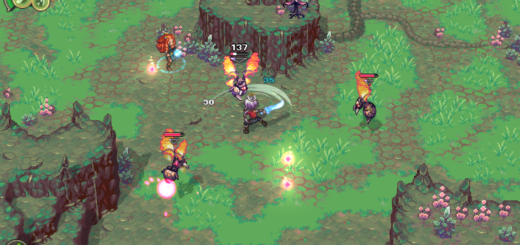
Montabi has a wonderful creature design aesthetic. The twenty-two Montabi have adorable and unique designs, with this reviewer being quite fond of Washette the washing machine. Washette has many washing machine-related puns in their abilities, and sports a very cute design. Every Montabi has a lot of interesting design details, such as Cabpod’s evolutions, which start at a small cab and then evolve into a large upscale taxi cab. There is a playfulness in Montabi‘s character designs and world that is definitely undeniable. On the other hand, all battle locations look completely the same, with the exploration areas being simple and not exciting to look at. There is no voice acting to speak of, and there is only a small handful of tracks, which, while decent, do not stand out.
There is a lot to like about Montabi, as it does a great job of pulling the player in and hooking them into the game’s very addictive game loop. Every run feels chaotic and random, and on top of the adorable Montabi themselves, there is a lot to like in this tiny package. It’s so easy to want to push through, see what kind of boons one can acquire, and run through the three main areas over and over again, as a run to the end will take you up to thirty to forty-five minutes max per playthrough. It’s just a shame that this creature-collector roguelite has such a bare-bones story and performance issues on the Nintendo Switch that prevent it from true greatness.
Disclosure: This review is based on a free copy of the game provided by the publisher.


Addictive gameplay loop
Washette is best Montabi
Crashes and slowdown common
Story and "plot twist" is barebones




Recent Comments