Kingdom’s Return: Time-Eating Fruit and the Ancient Monster Review
Suffering from Simplicity
Oftentimes, the simplest approach is the best one. However, where does one draw the line between simple and mediocre? Kingdom’s Return: Time-Eating Fruit and the Ancient Monster, a remake of a mobile game by Inti Creates, is a light-hearted 2D action-strategy RPG that blends side-scrolling combat with a city-builder. Here’s a game with an amusing title, I thought. I plow through dungeon after dungeon, eagerly anticipating an entertaining story, and roll up my sleeves to build the best kingdom Almacia has ever seen, only to get to the end to exclaim incredulously to myself, “But this can’t be all there is!” Although this latest Kingdom Returns sports a beautiful presentation and an exciting hybrid of action combat and city-building systems, it unfortunately lacks the depth that makes it stand out amongst other modern RPGs.
The Kingdom of Almacia is facing a time of unprecedented crisis. It has somehow been sent to the distant future, where it has fallen into ruin and needs to be restored to its former glory. Fairies have long aided adventurers on their travels throughout the continent of Norlant, but most have disappeared in recent times. Playing as a silent and lone adventurer, players form a pact with the charming and wise Chronos, the Fairy of Time, to complete missions and gather materials for rebuilding Almacia, while trying to find out who is behind the kingdom’s strange predicament.
After a solid narrative setup, players are off to start restoring the kingdom immediately. However, it’s not long before the story pacing starts to feel off, and in a short game like Kingdom’s Return, it’s the kind of misstep that one can’t help but notice quickly. Many hours and whole areas later, the story presents itself again, but ultimately falls flat with minimal emotional impact. Although the dialogue is humorous at times, there is no character development or sense of immersion, as most characters don’t have a name or personality. The protagonist, simply referred to as “adventurer” by everyone, is a blank slate, which unfortunately makes the narrative feel even emptier.

Are you tired of having to carry the story, Chronos?
There are four classes to choose from, each with its own appeal. The Imperial is a balanced fighter, the Zipangu trades stamina for strong offense and mobility, the Alchemist is an innovative yet fiddly class that utilises status effects, and the Wizard is the stereotypical glass cannon, with weak defense but powerful magic. Players are asked to select one character to start the game with, but are given access to all characters in the same playthrough.
Though this sounds versatile, in practicality, the game design is at odds with this approach. Each character exists in their own little bubble with no synergy, despite having complementary skills that would work well in a party. They start at level one, do not share experience, and are not permitted to swap at any time in the overworld or dungeons. Maximising each character therefore requires quadruple-handling the already repetitive dungeons and missions in Kingdom’s Return, making for a tedious and unrewarding time.
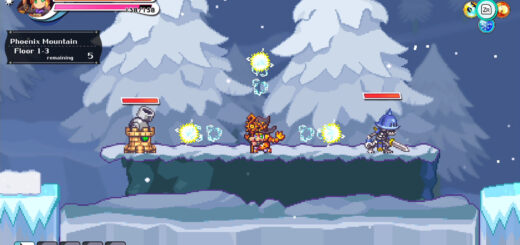
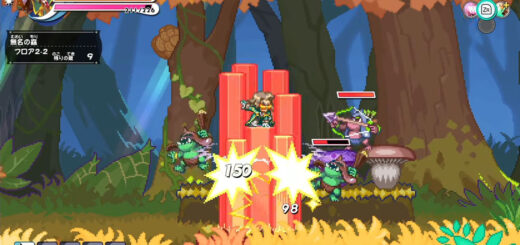
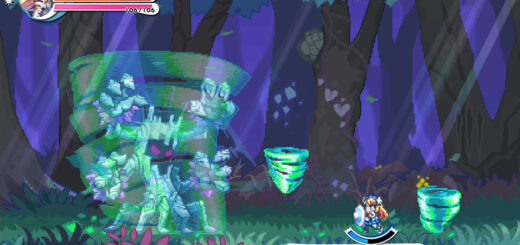
Combat in Kingdom’s Return is a 2D action side-scroller, with players needing to fully clear each room of enemies before they can progress. In combat, players can execute attack combinations, dodge, guard, use items, gather materials, and interact with hazards or collectibles such as chests or power-ups. Characters have HP and stamina bars, where both can be replenished with items, though stamina also naturally replenishes over time.

Players can examine the entire Class Circle from level one.
Players will find that combat against regular enemies is quite forgiving, and while bosses can be challenging at first, studying their attack patterns will make quick work of them. Upon leveling up, characters gain permanent stats and Class Points, which can be used to acquire new skills or stats in their Class Circles. The Class Circle system is extremely straightforward and has some neat skills, but once again lacks depth. Player strategy only goes as far as choosing the order to learn skills.
To head out into the overworld, players must accept one mission at a time and, once they’ve left town, they cannot return until it’s completed. Traversing through the overworld leads players to dungeons, where the main mission objectives lie. Each floor in a dungeon is made up of areas, with the top floor usually reserved for a boss. There is a fixed number of enemies, materials, and hazards on each floor, increasing in difficulty the deeper players delve into the dungeon. Additionally, dungeons can only be escaped after completing a mission or reaching the end.
Kingdom’s Return has some really fun and creative level designs, but is again let down by not having enough variety. The game relies on completing the same dungeons over and over for story missions, and the novelty wears off quickly. Players find themselves facing the same variation of enemies with predictable attack patterns, and each dungeon a replica of one another with similar structures. While there is nothing inherently wrong with grinding in a game, it does not feel stimulating here.

Not taking an arrow to the knee today in this Nameless Forest.
To make it worse, items are extremely lacking in use and design in Kingdom’s Return. Players cannot purchase any items in town, so they must make do with their three potions for each mission. Any other items found, which are fairly sparse, are automatically handed in for cash if they are not consumed in the dungeons. Additionally, the boosts that some of the items have are minuscule, such as boosting attack by one stage for a few seconds, and are more worth their weight in gold instead of combat.
When players are not out adventuring, they are restoring their fallen kingdom in Kingdom’s Return. Unfortunately, the city-building system is incredibly rigid and uninspiring. Chronos uses the player’s gathered materials to rebuild the town and to initially help set up the castle, which is untouchable for the rest of the story. Apart from that, players can build the kingdom as they see fit, choosing from options such as a weapon or armor shop, inn, and aesthetic items such as trees or statues. Each building can be upgraded a few times, with each upgrade requiring materials and a construction cost.
Upgrading buildings adds stat bonuses, allowing players to choose which stats they want to invest in. However, there is an arbitrary limit on how many buildings can be established based on the level of the castle, which is dependent on the haphazard story progression. Adding any extra buildings beyond this soft limit is detrimental; and instead of being a fun, strategic decision for the game, it reduces player agency and punishes players who find themselves ahead. Additionally, the appearance of buildings cannot be customised in any way. Players will find themselves stagnant quite often because of the limited possibilities.

In the wise words of Chronos: If you build too many roads, your town’s aesthetics will suffer!
The world of Kingdom’s Return also feels lifeless. There is no sense of gratification or a meaningful way to tell if the kingdom is flourishing under the player’s management. A handful of generic villagers unlock upon having their buildings restored, but their only means of conversation is to offer scripted, optional, and mundane side missions. Players can visit the castle or the fairy fountain, but there is no real incentive because the interaction isn’t overly helpful or rewarding. Furthermore, there is not much to engage with in the map-less, barren overworld that features a costly fast-travel option, a couple of random treasure chests, and placeholder enemy sprites for combat, primarily there for the purpose of town missions.
The main appeal of Kingdom’s Return is the gorgeous visuals, pleasant soundtrack, and smooth gameplay. Kingdom’s Return features lovely pixel art sprites during combat sequences and city-building, and switches to a bright and colourful, high-fidelity anime-inspired art style during dialogue and cut-scenes. These pair nicely with the game’s soundtrack and its overall tone, which is also cheerful and upbeat. Combat is wonderfully animated and largely satisfying, particularly during the intense boss sequences and when wiping out multiple enemies with a well-timed attack combination.
The one-dimensional world, scarcity approach to strategy, and an underwhelming city-building experience make for a very lacklustre time in Kingdom’s Return. Although it has the trappings of an excellent action-strategy RPG, it is disappointing to see simplicity squander its potential. Newer or casual players will likely find more enjoyment in Kingdom’s Return, as the game is not demanding in time or learning curve. Seasoned players may find Kingdom’s Return to be a sufficient side game, played in casual, short bursts in between more complex and ambitious RPGs.
Disclosure: This review is based on a free copy of the game provided by the publisher.

Gorgeous graphics
Cool character classes
Cheerful and light-hearted presentation
Moreish side-scrolling combat
Limited city-building capabilities
Not much strategy for a strategy game
Repetitive missions and dungeons
Minimal interactions with NPCs and the world
Under-developed story and characters




Recent Comments