Culdcept Begins Review
Daddy Issues, the Board Game
Digital deck-building RPGs have become a dime a dozen in recent years, with a multitude of popular titles demanding players master their intricate systems. After a decade-long absence from the gaming landscape, the Culdcept series returns with Culdcept Begins, attempting to fuse the cutthroat board-game mechanics of Monopoly with the strategic depth of deck-building and monster battling. It is a bold, ambitious trifecta on paper, but in practice, the game fails to fully commit to any of these identities. By trying to be everything at once, Culdcept Begins struggles to find a hook, resulting in an experience that feels less like a polished hybrid and more like a collection of mechanics in search of a soul.
Culdcept Begins places players in the shoes of Kamru, a young prodigy enrolled at the Cept Academy. Much like the magical fantasy school settings found in countless other RPGs, the time spent at the academy involves honing skills as a Cepter—someone capable of wielding powerful cards called Culds. However, the narrative quickly outgrows the classroom. Kamru is soon tasked with gathering four elemental sigils to maintain a massive magical barrier protecting the kingdom of Bavrashka from encroaching, abyss-dwelling threats.

A sidequest memory reveals the beginning of Kamru’s school.
The story plays out like a paint-by-numbers JRPG; it lacks real low points, but offers nothing that will truly surprise or delight. While the initial setup is intriguing, the narrative suffers from a lack of clarity or depth, often feeling like a checklist of tropes ready to propel the player to the next board game match. The main quest revolves around Kamru’s journey to defend his country and figure out what happened to his absent father, while a small handful of side missions help flesh out past events and provide additional character depth. While the cast—such as Kamru’s classmate, Ishara, who has her own daddy issues with the local monarch, or Kamru’s rival Tarhunt, who goes through his own small family drama—adds some flavor, the localization often feels functional rather than inspired. It is a story that exists solely to drive the gameplay forward; it rarely demands emotional investment.
The core gameplay is where Culdcept Begins feels stalest. While three interesting mechanics are at work, none feel truly exceptional. The loop is occasionally addictive in short bursts: move around a board, claim territories by placing monster cards, and extract “magic”, the game’s currency, from opponents. It is essentially Monopoly or Itadaki Street with a fantasy coat of paint. While this is a tried-and-true mechanic, the execution holds it back. Unlike Monopoly, bankruptcy is impossible; losing magic simply resets a player’s standing. Consequently, the primary goal, reaching a magic threshold and racing to the start, often happens organically. Whole games can feel like a lonely stroll in circles, with very little meaningful interaction between players. Matches are often over in 10–20 minutes, and while this makes for a speedy experience, it rarely leaves enough time for players to meaningfully develop their territories.
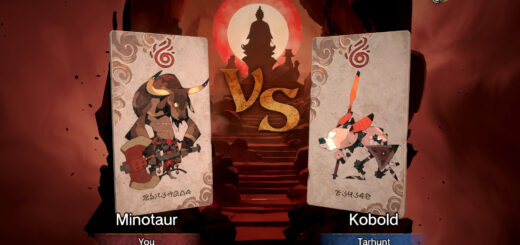
When a player lands on an opponent’s claimed space, the game shifts to a monster battle. A creature is chosen from their hand, potentially bolstered by an item or spell, and the combat resolves in an abrupt exchange: one hit apiece, and the weaker creature is wiped from the board. If no monster is destroyed, the attacker is simply repelled. These one-note battles lack any sense of tactical depth and are routinely decided by whoever holds the superior item card. While the hundreds of available monster cards—each with specific offensive or defensive traits—do provide a layer of depth for those inclined toward the included online PvP, this complexity is largely wasted on the relatively easy story campaign.

Reaching the end space first can result in a victory despite not finishing first in score.
Besides monster and item cards, there are spell cards that can be played during the movement portion of players’ turns. These can limit dice rolls, boost them, steal magic from other players, or impart effects on certain properties on the board or the monster that defends them. The strategy here can be deep in the deck-building phase outside the board game battles. Building a deck of 40 cards requires balancing creatures for early board presence and late-game defense with creatures that have enough attack to defeat opponents’ creatures. The inclusion of elemental chains and terrain bonuses rewards thoughtful placement, and the sanctuary and shrine spaces add a small layer of complexity when present. However, the game has a fundamental pacing issue. With a 40-card deck and a match length that rarely sees you cycle through your entire hand, players are at the mercy of the draw. Players can hold on to a hand of up to seven cards and deploy them when needed, but far too often games end without a significant portion of the deck even being drawn.
For all its strategic veneer, Culdcept Begins often feels like a series of 20-minute sessions decided by a single roll of the dice. Decks that dominate one encounter can be soundly crushed by the exact same opponent in an optional side quest moments later. Throughout the campaign, many battles are won not by tactical brilliance, but by fortunate rolls that allow the player to reach the finish line first while opponents are also sitting on winning scores. Outside of a few pivotal late-game encounters, the entire experience feels remarkably easy, requiring little in the way of forethought or deck iteration. In fact, the auto-battle feature often feels safer and more expedient than taking manual control, leading to a pervasive and frustrating lack of player agency.

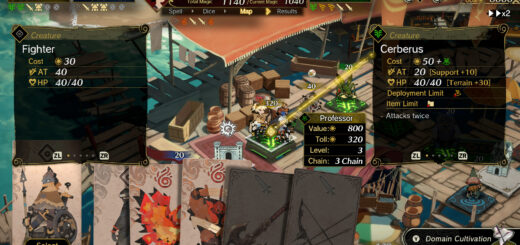
The visuals are a treat, and the way a plethora of information is provided at a glance is a standout feature.
Both visually and aurally, Culdcept Begins succeeds in creating a cohesive, vibrant experience. The art direction utilizes a colorful, stylized aesthetic that gives the world and its inhabitants a distinct, lively personality. The card designs, which represent monsters as ancient stone tablets, are rendered with impressive detail and thematic consistency, making the collection feel like a single, cohesive TCG release. This visual clarity extends to the user interface, which is remarkably well-designed; it communicates complex board states, hand contents, and elemental affinities at a single glance, ensuring that even the most crowded matches remain readable. The soundtrack complements this atmosphere nicely, offering moody, thematic scores at the start of each match that build into more exciting arrangements as the action intensifies. While they fit nicely, they’re nothing that would stand out on their own; functional, but not fun.
For fans of board games or the Culdcept series who enjoy playing with others, the online multiplayer and local multiplayer—available via the Nintendo Switch 2’s GameShare feature—make Culdcept Begins a worthwhile pickup. For the solo player, however, the predictable narrative tropes and the inherent randomness of the gameplay make it difficult to justify the time investment. Culdcept Begins is a competent, if slightly dated, strategy experience; it serves as a functional return for the franchise, though one that occasionally relies too heavily on the simplicity of its past.
Disclosure: This review is based on a free copy of the game provided by the publisher.


Exceptional UI design conveys a lot of information brilliantly
A colorful and cohesive art design make the game a delight to behold
Both online and GameShare multiplayer are good inclusions for a board game
RNG dependency outstrips player skill
Single-hit combat lacks strategic complexity
Players rarely see their entire deck in a single game





Recent Comments