Cassette Boy Review
It’s All About Perspective
“If you can’t see something, does it cease to exist?” It’s a rather heady question, bringing with it discussions that could roll together quantum physics, causality, and the basic realities of human perception. But that question isn’t in our purview right now, so let’s jump back to a different one. “If things you can’t see don’t exist, how can you build a game out of that?” Enter Cassette Boy, an action adventure RPG developed by Wonderland Kazakiri Inc. and published by Pocketpair Publishing.
Right off the bat, Cassette Boy hits the audience with its premise. The player stands in a void with a mysterious cube floating ahead, and it makes a startling claim. “The moon’s gone. Because you weren’t looking.” Walking across the void, the hook of the game is revealed in full. It’s not just the moon that can vanish, anything that can’t be seen stops existing. Pushing a box behind a wall means it can now be walked through and can’t be grabbed again, while a button on the floor opens a gate, but once it’s obscured, it can no longer be found.
Armed with this knowledge, the task ahead is laid out simply. Moon Fragments have been scattered across the world and creatures who find them go mad. The damage can be fixed if the Fragments are brought back together. After a fade-out, the main character, an unnamed kid made of white blocks, wakes up in bed and the adventure begins.

Don’t look away.
When first stepping outside of the house, it’s immediately clear what kind of game Cassette Boy is. At the base level, this is a Zelda-style action-adventure. The world is navigated from a top-down perspective, and the player quickly gets a legendary sword out of a stone. Sword in hand, there’s monster-filled dungeons to be conquered across the world, where new powers can be obtained and Moon Fragments inevitably awaiting at the end.
Combat is a simple beast here. The sword serves as the main attack. A bow and bombs are also obtained over the first few dungeons, completing a classic arsenal. They are less easy to use than the sword, but they still have some use. And that’s about it for combat, actually. From the moment the bombs are found to the final boss, combat does not change. Use the sword as a primary attack and use the other weapons when the need arises. Learn how monsters attack, then dodge the attack. It’s a system that operates at a very fundamental level. The player character levels up by getting Experience from defeating monsters and using items, but leveling up is simply a means of improving stats. No new techniques are learned to spice up the combat loop.

Link would be proud!
However, fighting monsters is not the main point of this game. It’s time for that big hook about making objects disappear to make a grand entrance. In the first dungeon, a nifty pair of headphones can be found that lets the player “focus” better on the surroundings. What does that mean? It means that the camera can now be rotated in set intervals with a button press, and when things stop existing if they’re obscured, that opens a lot of possibilities.
Take the most basic example, which the game uses immediately after getting the headphones. A large obstacle blocks the way through a tunnel. There’s no way through, but the obstacle is flanked by walls. After turning the camera to the side, the obstacle is covered by the wall, and as it doesn’t exist while it can’t be seen, the tunnel is cleared.


“Out of sight, out of mind”, as they say.
Cassette Boy finds a surprisingly diverse array of puzzles to solve from this concept. Boxes become mobile walls, while when a button disappears, the mechanism it’s linked to becomes locked in place. Bombs or arrows can be disappeared, but can pop back into existence when needed with a turn of the camera. There are even mechanisms that operate by reacting to the camera turning, as well as cassettes to listen to that further alter perception. All of these are building blocks for a variety of puzzles. Throughout the game they stay fresh by introducing new mechanics, and the hardest of them can be real brain-ticklers. This is especially true in the optional Shrines, which have tough puzzles that often require the manipulation of multiple objects.
This isn’t the first game that uses perception as a puzzle-solving tool, but the game picks an interesting core mechanic from such a concept and makes a lot out of it. The biggest flaw with the system is that it doesn’t interact much with combat. A scary enemy can be manipulated into walking behind a wall to make it vanish, and most bosses have some kind of view-based trick implemented into the fight. Most times, though, it’s strictly an exploration and puzzle-solving mechanic.
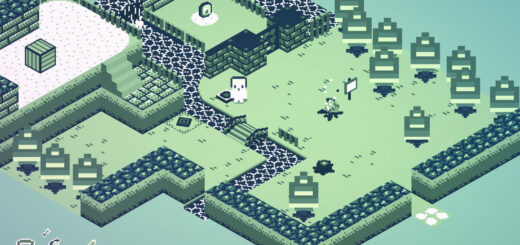
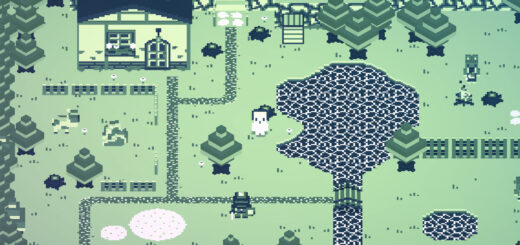
With the ability to look at things from all angles, a good sense of the game’s visual style quickly emerges. Cassette Boy is a 3D game that uses a combination of blocky models and limited colors to mimic the look of 2D sprites. In particular, it’s clearly meant to emulate the look of the original Nintendo Game Boy with its prominent green hues. When looking at things from a direct angle, this illusion works nearly perfectly. The retro vision is fully achieved, but it does cause a few small hiccups. While the game looks most authentically retro from the front, it is also the roughest angle to look at it from. The limited colors and use of square geometry make character models look flat and low-detail when viewed directly, though the pixel-art portraits help get the design across. It also causes some issues properly perceiving height and depth, which can be crucial for figuring out a puzzle. The best way to view the game is actually from a diagonal angle, since that helps the depth pop out.

Meet Mom. She looks a little rough from this angle.
Another retro-style element is the music. Chiptune inspired synths are the focus of the melodies, but this soundtrack is more sophisticated than 8-bit tunes. Modern synths, bass, and percussion fill out the tracks, creating an uncanny experience of hearing music that’s somewhere between 8-bit and 16-bit. While there are a few high-energy tracks, the soundtrack mostly stays cool with low tones, slow tempos, and glittering synth chords. It’s a perfectly fitting soundtrack for traversing strange lands and working the brain while traversing them.
The story of the game is simply serviceable and little more. It’s a bit thin and just set dressing for the puzzles the developers crafted. The task is restoring the moon, and that’s all. There are a few characters who stand out, like Rudin the wannabe hero and Milo the monster part connoisseur. Occasionally, the story plays with pathos as well. It touches briefly on fears of losing things and people important to oneself, like looking for a lost cat or helping an old man cope with grief. It smartly ties to the mechanical theme of things suddenly disappearing when unobserved, but it only crops up in small moments and never really connects to a larger plot. In fact, the plot takes a wild twist in the endgame with very little buildup. While it is interesting and provides a cool finale, it’s not very deep.

Tobias here has the most heartfelt conversation in the game. It’s just one conversation, though.
There are some issues with this game that may turn a player off it, though, most notably with its structure and direction. Structurally speaking, the game’s back end feels lighter on content than the front. For most of the game, finding a Moon Fragment means going through a whole dungeon, solving a battery of puzzles, and facing off with a boss at the end. The final few involve doing a series of side-quests around the town to unlock small new areas with only a little bit to do in them. The endgame doesn’t even have a final dungeon that pulls the mechanics together. It’s just a set piece leading into the final boss. It leaves the ending a bit rushed and anti-climactic.
And then there’s the lack of direction. The game is content to drop the player back at home after every Moon Fragment and just trust them to figure out what to do next. This isn’t too bad at first since there will be unexplored and blocked-off paths that are obvious next steps, but the back end of the game is quite bad about this. Those side quests for the final Moon Fragments are lengthy, as it’s expected for the player to check in with them throughout the game. However, the quests will update with almost no indication, and it can leave a player scrambling to figure out what they should do if anything is missed. One of these quests also makes the collection of the seemingly optional Ancient Coin collectibles mandatory, leaving the player to scramble once again if they were unprepared. There is a Memo tab in the menu that does post reminders for quests that have been updated, but there’s no notification that the Memo has been updated. The Memo tab itself is a post-launch addition, meaning that players at launch had an even tougher time of it.

The Ancient Coin trade shop. Several of these items are NOT optional.
This leaves Cassette Boy as a brilliant concept held in a flawed shell. The perspective-based puzzle mechanics are clever and well-explored, providing a real sense of satisfaction when those solutions click and the full potential of snapping objects out of existence is realized. The music is a great soundscape for said puzzle solving. The graphics are a little muddy from certain angles but ultimately deliver their intended retro effect convincingly.
The rest of the game, however, is simply a serviceable Zelda clone. Combat is fun enough, but rather basic. The story isn’t anything to write home about. Then the final stretch of the game is marred by underdeveloped final areas and mandatory side-quests with poorly communicated updates. At the very least it should still leave an impact with its concept, and that’s a good thing. After all, if a game is forgotten, does it cease to exist?

Perspective-based puzzles are clever and well-developed
Soundtrack combines chiptune sounds with mellow modern ambience
Convincing pseudo-retro visuals
No story of substance materializes despite some attempts
Final act is marred by underdeveloped areas and lack of direction




Recent Comments