Bravely Default: Flying Fairy HD Remaster Review
Familiar Scenery
The Nintendo Switch 2 is here, and Square Enix has resurrected a decade-old 3DS classic for the hybrid handheld’s momentous launch. Bravely Default: Flying Fairy HD Remaster is a timely return to the realm of Luxendarc that has been polished for new and better hardware. While the remaster doesn’t address flaws that plagued the original release, it preserves its strengths and makes some improvements elsewhere, making it the definitive version.
All seems well in Luxendarc until a great chasm appears, causing the four crystals that kept balance across the land to fall to the darkness flowing out of the rift. Many lose everything in the ensuing chaos, with Tiz Arrior among them, a humble villager at the wrong place at the wrong time, forced to mourn as his hometown of Norende and his brother Til are swallowed up by the chasm. The visiting Vestal of Wind, Agnès Oblige, sees his sorrow and the tragedy of Norende firsthand, and vows to restore order in the world by reawakening all four crystals through the powers granted to her as a guardian of the Wind Crystal. Together, with the playboy amnesiac Ringabel and unflinching knight Edea Lee in tow, they venture on a quest across Luxendarc to stop the rising darkness before it’s too late.

A chance meeting sets alight a spark of hope.
It’s a traditional story at its core, one of destined warriors and magic MacGuffins, and it wears that on its sleeve. Though it works some metaphysics into its late game, it remains grounded in its fantasy setting and doesn’t become something different than what it bills itself to be. Its characters are similarly tropey, yet well suited to the kind of story on display. Each of the four heroes is likable in their own way, and the optional party chat sequences where they bounce off each other make them all the more endearing. Tiz is the simplest of the bunch, but not every character needs an extensive arc, and certainly not one whose defining trait is humility.
Unlike its heroes, however, the game’s villains are lackluster. They’re either delusional or barbaric to the point of excess. The first kind is just as intolerable as the second, as they refuse to explain their motivations and the hidden truth they claim to know, even when doing so would help their own cause tremendously. Both types are more caricature than character, but their one saving grace is that battles with them present a new challenge for the party and yield significant rewards upon victory.
Despite the villains’ poor showing, there are still a handful of moments when the storytelling surpasses expectations. Twists fuel its late game, and some of the party chats blossom into poignant discussions on war, tragedy, and how people react to changes in the world around them. These moments, while uncommon, prevent the story from feeling banal and safe.

Underestimate foes at your own peril.
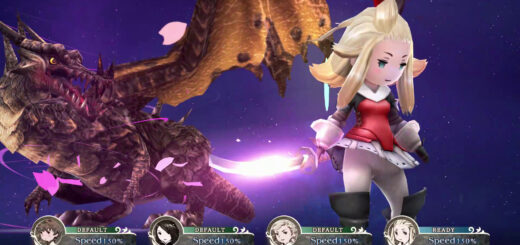
While the story doesn’t excel, the gameplay does. Players can expect RPG staples like turn-based battles, random encounters, dungeon exploration, job-based team customization, and challenging boss fights that will push them to aim for combat mastery. The series’ trademark Brave/Default system is nothing short of genius, even in this first installment. Every action in a turn costs Brave Points (BP), but the Brave function allows multiple use of BP within the same turn for attacks, buffs, and/or healing, while the Default function reduces damage from enemies and stores BP for the next turn. Excessive Braving results in a BP deficit and temporary immobility, however, which encourages tactical use of the two options depending on the situation at hand.
Enemies will Brave and Default themselves to tip the scales in their favor, which must be met with a daring strategy that counters them blow for blow. Just as the player’s aggression can be turned against them, the same can be done to the enemy, resulting in a battle system that is balanced in its treatment of both sides and fair in its difficulty. The game is moderately challenging on Normal, with some roadblock bosses that will force players to rethink their approach and their party loadout. But the difficulty can be circumvented by switching to Easy, grinding, summoning high-level friends in battle, or running with overpowered builds.
Team composition has substantial depth as abilities from different jobs can be equipped at the same time, and certain ability combinations deliver incredible results on the field and in battle. For example, the Red Mage’s “Turn Tables” skill racks up additional BP after evading attacks, which pairs well with the Ninja’s unparalleled evasive abilities to create a dodge-tanking BP battery that never fails to meet the moment. Grinding for Job Points is needed to unlock builds as effective as the one above, but the return on investment is always worth the trouble. While leveling up through experience points is very important to staying alive, leveling up Jobs is where the fun is, and completionists will lose dozens of hours while maxing Jobs out without even realizing it.

Special Moves are the cherry on top of a battle system that is already fast and flashy.
Jobs are gained through the main quest and optional sub-scenarios, but a majority are found through the latter. Though optional in theory, sub-scenarios are essentially necessary due to the immense utility of some of their jobs. They double in providing worldbuilding and character development, on top of some truly challenging boss fights. The only other sidequest has to do with rebuilding Norende, but it is simple and can be done rather quickly, while sub-scenarios are more engaging and difficult. They can also be done all over again in the second half to fight stronger versions of the bosses and learn more about them, though this time around they can be skipped without much of a loss.
Along with sub-scenarios, dialogue, cutscenes, and dungeon battles from the main story repeat too, without enough in the way of variation to justify the deliberate monotony. It serves both the narrative and the gameplay, but is a tough pill to swallow and upends what was otherwise a smooth and wholly enjoyable journey up to that point. Similar to the repetition in the Nier series, opinions will vary, but it is undeniable that it pulls the rug out from under the player and asks them to redo what they just spent dozens of hours doing.
The final nail in the coffin is that this part of the game only happens due to our heroes’ ignorance, in what can only be described as an “idiot plot.” There is a narrative reason for why this arc needs to be drawn out, but it could have been accompanied by the heroes playing a more active role. It isn’t nearly enough to make the party unlikable, but it is one more annoyance in an already annoying portion of the game. It’s the primary area where the remaster could have made significant changes, but it’s all left untouched.

Get your groove on with the new Luxencheer Rhythm Catch mini-game.
Besides the visual upgrade, the biggest change in the remaster is the addition of two mini-games: Luxencheer Rhythm Catch and Ringabel’s Panic Cruise. The former is a standard, if shallow, rhythm game with a selection of five songs and three difficulty modes, while the latter might be best described as an “anxiety simulator.” In it, the player pilots an airship while juggling several tasks and trying not to mess up. Both games use the Switch 2 Joycons’ mouse functionality, which is awkward but works for the most part.
The mini-games are serviceable, and high scores come with rewards to be used in the main game, including, strangely, the options to change the encounter rate to 0% or 400%, options that were base parts of the original. Street Pass was also a quirk of the 3DS version that’s been removed altogether. Players now meet randomly in the game world as long as they’re online, and can then be called upon in battle or to help rebuild Norende.
The menus in the bottom screen of the 3DS have been merged onto the single screen of the Switch 2. These menus are very simple and effective, but they take up a chunk of the screen regardless and even block some of the character models during the player’s turn. Other changes include the addition of a fast forward option during cutscenes, a “Heal All” button in the menu to instantly heal the party, the ability to save team loadouts, and a warning showing the recommended character levels for dungeons. Despite being based on the For the Sequel rerelease of Bravely Default — the version released internationally — the remaster removes the hourglass mechanic and other references to Bravely Second present in that version, though Nemeses fights remain.

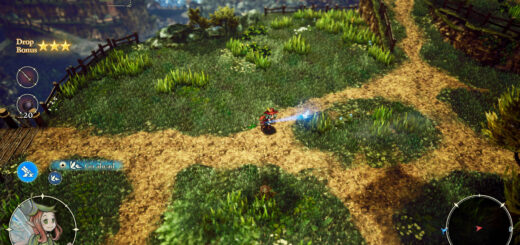
Luxendarc’s varied landscapes are now in HD and on the big screen.
True to its name, the remaster displays at 1080p resolution with consistent 60fps in both handheld and docked mode. The only flaw is the ten-to-twenty-second-long initial loading screen, but once in the game, loading usually takes less than three seconds. Most of its visual weaknesses, such as an overreliance on static cutscenes and the expressionless chibi models, are limitations carried over from the original. Some might prefer the original for personal or artistic reasons, but this version is superior from a technical standpoint. Generally speaking, however, it is an average-looking game that would have fit just as well on Switch without losing anything.
Revo, known elsewhere for his work with Linked Horizon and Sound Horizon, composes the soundtrack, which is always a joy to return to and perfectly accompanies every step of this journey. Standouts are the four character themes for the party members, as well as a few event themes that go above and beyond in making pivotal story moments memorable. The voice acting is praiseworthy as well, as both the English and Japanese casts are stacked with some of the best talent out there, but party chats remain unvoiced as in the original. The second half’s repetition, unfortunately, also exacts a price from the sound, with the repeated dialogue and area themes losing their punch after so many listens.
Bravely Default: Flying Fairy HD Remaster is exactly what it claims to be: a no-frills, touched-up rerelease of a beloved RPG. The mini-games are not enough on their own to warrant double-dipping, and some of its changes will take getting used to for fans, but both fans and newcomers can walk away satisfied with the updated visuals and features. Flaws of the original remain, as do its strengths, but a great game remastered is a great game made better, leading this to be the definitive way to play Bravely Default.
Disclosure: This review is based on a free copy of the game provided by the publisher.


Tightly-designed battle system that rewards strategy and encourages mastery
Maxing out Jobs is incredibly addictive
Lovable party members with banter that ranges from heartfelt to hillarious
Quality music and voice acting
Character writing loses its grip at times
Repetitive second half brings down the entire experience




Recent Comments