Thysiastery Interview
Old-school dungeon crawlers have had a niche in RPGamers’ minds since the beginnings of the genre. Developer DIRGA has taken this tried and true gameplay style, tosses in an interesting art style, mixes in quick-paced combat, and wraps it into an entertaining roguelike that provides Thysiastery with a lot of replayability. Those interested in learning more about the game can view the review found here. Joining RPGamer today is Creative Director SAS to talk about the current state of the game as well as some questions about its future.
Ryan Costa (RPGamer): How has the reception to Thysiastery been so far? Has there been any surprising discourse from players so far?
SAS: THYSIASTERY is our debut title. The reception has been positive and the game has sold more than we initially expected. I guess there was some surprise on how negatively some players viewed the soft turn-limits per Stratums.
RPGamer: In the continual aim to make a balanced experience, is the focus more on synergy with existing skills or adding new ones to make even more possibilities? Are there any abilities that players have surprised the team with how they were used?
SAS: Primarily we want to create more ways the runs can go, polishing out existing weaker archetypes. New synergies are something that we also want to develop more. As for surprises, it has been very exciting to see players find out-of-the-box combinations that end up being super effective in a run.
RPGamer: How expansive are the possibilities within each of the classes? It felt as though getting the same archetype still had a wide variety of possible abilities within multiple instances of finding that class during playthroughs. Are there skills that are locked behind particular classes?
SAS: The classes in a way aren’t very strict. Some have fixed skills, but outside of that, they more or less just determine certain preferences for skills and what skills they ban. Most of them are not locked, but there are some that only appear in certain classes.

RPGamer: A special enemy haunts players after spending a lot of time on a dungeon floor, reminiscent of classic dungeon crawlers. Was this a deliberate homage, and if so are there other moments that harken back to the classics of the genre?
SAS: It was not meant as a real homage to anything specific in particular. The idea was to escalate danger by increasing more dangerous monster spawns and then end up spawning something that would chase you out of the floor or kill you.
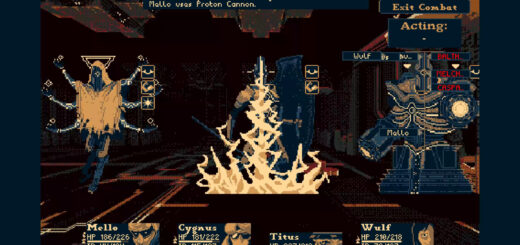
RPGamer: From backgrounds to monsters the coloured shading is quite pronounced in the retro visuals. How difficult was it to get the lighting and artwork to fit with the overall design?
SAS: It was some of the first things I tackled. The goal was to create a sort of ‘crunchy’ visual experience. Thankfully the shaders I wrote did a lot of the groundwork. The dungeon itself doesn’t have lighting, but there is a fog that limits range of vision. Making the sprites and models was relatively simple, though we did have to wrestle issues with ex. pixel perfectness and field of view.
RPGamer: Will the Summer update that mentions more equipment possibilities allow players to find more treasure on each map?
SAS: Not necessarily ‘more’, but the goal is to make equipment more impactful in general.

RPGamer: Does the merchant’s trade options always include items that players could have potentially found so far in the labyrinth or is it more randomized than it first appears?
SAS: They are largely random, scavenged things from all over Labyrinth, but there is some structure there on what is offered. I’d like to improve more on this to make runs more consistent. As an aside, originally I had an idea of offering items from previous failed runs, but we didn’t end up implementing it…
RPGamer: Future updates will add more monsters and biome bosses. Will the distribution of these new monsters be even between each of the stratum and what can players look forward to in how they will stand out from those already in the labyrinth?
SAS: Essentially we want to make sure that games don’t end up too stale or predictable, particularly early on. While our current focus is on the early game experience, we are considering adding new monsters in the late game as well.
RPGamer: With Thysiastery‘s dungeon crawling procedurally generated for most of the non-boss floors, it felt like an art to how winnable they felt, even in losses. How did you look to balance the challenge with the randomization?
SAS: It is difficult since the party composition and strength can vary between runs. We tried to look into what sort of power player would be at each Stratum, and try to give some leg up if there have been character deaths, so that even with some challenges the game remains winnable.

RPGamer: Have you put any consideration into further expansion of the world’s lore during any of these upcoming updates?
SAS: You’ll just have to wait and see!
RPGamer: Is there anything that you would love to share about the game not discussed above?
SAS: We’re very happy that our debut title has been well received. The community has played a big role in shaping what comes next. A lot of the upcoming improvements are based on player feedback and how they have experienced the game so far.
RPGamer would like to thank creative director SAS, for their time answering questions about Thysiastery, as well as Sarah Blackwell and Stride PR for making it all happen. Those interested in checking out this stylish old-school turn-based dungeon crawler can check out the game’s Steam page.






Recent Comments