Character Creation Goes Both Ways: The Proteus Effect
Let me paint you a picture. You buy a new RPG that lights your screen up with beautiful RGB colours that shine directly into your retinas like a straight shot of dopamine. You start the game, and you are presented with a blank avatar with the simple implied instruction of “Create Your Character”. You tweak the sliders ever so slightly so that Gordon Ramsay, in all his British glory, is perfectly replicated on your screen. You look up, and the sun has gone down. You spent five hours making Gordon Ramsay. You have work tomorrow. Gordon Ramsay looks back at you with disappointment. Damn, your recreation is perfect.
You have experienced or heard these types of tales before: “I spend more time customizing my character than I do playing the game”. Time investment signals importance because time is money, and we are all broke. Therefore, character creation must be a major priority for players. But why? And, are there other adverse effects of loving customization?

Baldur’s Gate III offers extensive character creation options.
The Importance of Self-Expression
Specifically in Western society, great importance is placed on individualism. Think about Voltaire and Rousseau during Europe’s Enlightenment period, y’know, the stuff you had to learn in high school. Being able to express oneself, whether physically or verbally, is the cornerstone of a person’s personality and individuality. As academics Kim, H. & Ko, D. state, “Self-expression allows people to distinguish themselves from others, to reflect their own beliefs and needs, and validate their own self-concepts” ([1], p. 4).
Characters or avatars are the player’s virtual visual representation, effectively a full skin suit (or animal suit, or other being). So, when players can make small tweaks to facial muscles to the hue of blue of their nail polish that don their character’s bodies, they are exercising their ability and desire to express themselves. Customization sucks up precious gaming time because of the importance of representation and self-expression. We all want to be true to ourselves. Therefore, when we enter a video game, we are excited to craft our beliefs, play styles, and ideas onto a physical canvas that is the character.
This is quite intrinsic to the human psyche: we want to decide how we look and, subsequently, how we are perceived. But can the opposite happen? Can the playable character’s visual representation change how players act?
The Proteus Effect
Yee & Bailenson[2] proposed the Proteus Effect in 2007: the effect that a player changes their behaviour based on their character’s visual representation. This hypothesis is based on behavioural confirmation, self-perception theory, and deindividuation theory. Listed here are the basic details of each theory:
- Behavioural confirmation: the expectations of person A cause person B to behave in ways that align with person A’s expectations ([2], p. 272).
- Self-perception theory: person A “observes their own behaviour to understand what attitudes may have caused them” ([2], p. 273).
- Deindividuated theory: when person A is in a group, their behaviours will match the group’s (for better or worse) ([2], p. 273).
Yee & Bailenson argue that these theories operate similarly in virtual environments as in reality, except for deindividuation. In reality, it is impossible to separate our physical representation from our identity; therefore, deindividuation only really occurs in large groups. In virtual environments, separation can occur since our physicality is not transferred into the virtual space. So, players can use their character as a uniform and create a new self, similar to how uniforms in groups (like cults) can make an individual part of a collective.
They used two studies to support their theory:
- Players were placed in a virtual reality space and interacted with a researcher reading a strict script. Players were able to see their character’s physical features for 60-75 seconds ([2], p. 280). Yee & Bailenson proposed that the closer the player was and the more willing they were to disclose personal information to the researcher, the more attractive their character was.
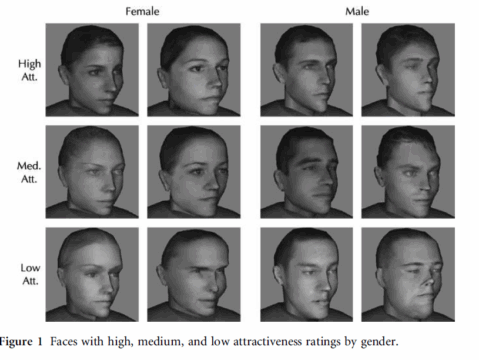
The different avatars participants were given ([2], p. 282)
- Players were placed into a virtual reality space and played the “ultimatum game”. This is when player A is given a sum of money. Player A proposes a split with player B. Player B can either accept the offer or reject it, leaving both with nothing. Height was manipulated for player A and Yee & Bailenson theorized that the taller the character is, the “more confident” and “willing” they will be “to make unfair splits” with players with shorter characters ([2], p. 282).

In both experiments, Yee & Bailenson’s hypotheses were correct. Players with more attractive characters were more open about themselves and would stand closer to the researcher. Players with taller characters were more aggressive and unfair in negotiations. In other words, there is evidence that a player’s character can influence and change the player’s game behaviour.
Application
From a researcher’s point of view, this is super cool: behaviour prediction based solely on visuals opens doors to so many more possibilities and experiments. For the causal gamer, what can they glean from this academic study? I believe Yee & Bailenson’s research paper lends a critical eye to the subtle ways game developers and companies’ show (and possibly manipulate) how they would like players to behave.
In video games that feature premade characters, their physical features can determine the vibe and expectations of the game. Take recently-revealed Pokémon spin-off Pokémon Pokopia. The September 2025 trailer showcases a cute young female playable character with short brown pigtails and a fun purple vest. Even the male character follows the same silly-looking design. Therefore, we can conclude that The Pokémon Company wants players to act in a wholesome way, matching the nature of the video game. Obviously, there are other factors at play here: video game aesthetics, themes, and tone that influence pre-made character designs.

Pokémon Pokopia’s announcement trailer focuses on a cute female character option.
Games with extensive character creation menus shape player attitude. If you create a character who looks like a cowboy, you may suddenly find yourself acting more like a cowboy, complete with “yee-haw”s and “howdy”s. Albeit an exaggeration, physical self-representation, virtual or not, changes how people act and behave. In these cases, the Proteus Effect may act more like a feedback loop: the player makes a character based on their beliefs, and the character’s physical attributes influence the player’s in-game behaviour.
Either way, our physical representation, whether real or virtual, has the potential to affect players in subliminal and unconscious ways. So, yes, spend five hours making a Gordon Ramsay look-alike avatar, but don’t be surprised if you start talking in a British accent.
Sources:
[1] Kim, H. & Ko, D. (2007). Culture & Self-Expression. Frontiers of social psychology: The self.
[2] Yee, N., & Bailenson, J. (2007). The Proteus Effect: The Effect of Transformed Self-Representation on Behavior. Human Communication Research, 33(3), 271–290. https://doi.org/10.1111/j.1468-2958.2007.00299.x



I think the only thing Yee & Bailenson proved was that the dumber one is, the more they can be manipulated.