Naoki Yoshida Interview
During the recent PAX West in Seattle, RPGamer was able to sit down with Naoki Yoshida, producer of Final Fantasy XIV and Final Fantasy XVI. He talked about to talk about his career in the industry, how he got involved in Final Fantasy XIV, and how he hopes to continue to try and bring in new players to the game.
Sarah Ferries (RPGamer): How did you get from Hudson Soft to Square Enix? Why do you think you were picked to “fix” Final Fantasy XIV?
Naoki Yoshida: First, after Hudson Soft, I transferred to another game development company within Japan, in a city called Sapporo within the prefecture of Hokkaido, called Rocket Studio. They still exist to this day, and then once I went through Rocket Studio, then I moved on to Square Enix.
Rocket Studio, while an independent studio, was comprised primarily of board members or upper management from Hudson Soft, as well as staff members within that company. So I was familiar with all of the people there. While the members went independent and set up Rocket Studio, I was still at Hudson Soft working on Bomberman. I stayed with Hudson for about a year working on Bomberman.
Then Hudson Soft was going to be moving on to their new project, and we were about to start a new production. Pre-production started and three and a half months in we had a fairly stable build. We were preparing to go into full production when I was called in by my section manager.
I was told by them that the project is going to be canceled. I didn’t understand it; we had sign-off from the company, we had the sign-off from all the leads, and the president. That manager was saying that, “Well, of course, if I leave it up to you and your team, I’m sure you can make something really nice, but I want to make toys that would be sellable to kids.” I was not under that mindset that these are supposed to be like children’s toys! Bomberman as well. I was very serious about what I was doing, so I told my manager that I can’t work for a company where the upper management thinks that these things are just toys to sell to kids, so I’m going to quit. That’s how I left Hudson Soft.

Explosive Bomberman 2, released in North America as Bomberman 64: The Second Attack!
Naoki Yoshida: After I left Hudson Soft, I was looking into other studios in Tokyo. I really loved Chunsoft; at the time they were still an independent development studio [Ed. note — Chunsoft merged with Spike to become Spike Chunsoft in 2012]. I was really admiring their works, so I was torn on whether to go there or to see if I could work with Yasumi Matsuno, who’s of course famous for Final Fantasy Tactics. At the time, I believe he was at a studio called Quest. I was torn between those, and then I got a call from my colleagues, or former colleagues now, at Rocket Studio saying, “Hey, I heard you left Hudson Soft. We have a lot of projects on hand, and we’re kind of scrambling around. Would you like to help us?” So that’s how I went to Rocket Studio.
I was with Rocket Studio for, I believe, four years. The company was comprised of a lot of engineers, and the president of that company is a very skilled developer as well. I think he’s a genius. But none of them were very good at sales and marketing or pitching ideas. Of course, as a development house, we needed to get clients, work with publishers and clients, pitch our ideas, or reach out to potential clients. My colleagues were not very good at communicating or trying to get ideas pitched in. So while I was working on two different projects and designing games, I would frequently go to Tokyo, try to pitch those ideas and presentations. Through that, I had the opportunity to work with Enix, before the merger between Square and Enix while they were still different companies. I was able to work with them on a project that I had the opportunity to design from the start up. It was an online RPG.
That online game that we worked with Enix to publish while Enix and Square were merging. So I was starting to get work that was also part of that post-merger company, like getting PlayOnline set up. The game that I had worked on was initially on the PC, but I was also assigned to make it compatible for PS2 as well, so there was a lot of work during that three or four years.
Once that project was concluded, Yosuke Saito, who’s still with Square Enix overseeing the NieR franchise, came to me and said “I heard you’re in Tokyo for your business trip. Would you mind coming to the Shinjuku office to talk a bit?” I was like “okay, Shinjuku office, I’ll go.” In the room was this whiteboard, and Saito-P pitched this idea about “Dragon Quest Online”, and that was my entryway into Square Enix.
Of course, with Rocket Studio, I was very close to them, especially the president. He took care of me really well under his wing. I was really torn about transferring out of Rocket Studio to Square Enix. I consulted the president, his name is Mr. Takebe, and he’s still with the company, leading as the president. I opened up to him, and I told him that Square Enix had offered me this opportunity and what should I do? He thought about it because I’m sure it would have been hard for him too. He thought about it for a little bit, and then he responded back: “I would miss you if you left Rocket Studio, but I feel like you should go to Tokyo. When I was with Hudson Soft, I was suddenly called to go to America.” Mr. Takebe went to America for three years. “My experience, my field of vision had expanded so greatly with that experience. I would recommend you to go, but promise me two things. First, because you’re going to a company like Square Enix, I want you to climb to the top. I want you to get to board member status. Second, please give us work to do.”

Dragon Quest X
Naoki Yoshida: With Mr. Takebe’s encouragement, I was able to join Square Enix. Then I worked on what became Dragon Quest X. I also helped out with some support items on Dragon Quest IX. Then I also helped with the project for Dragon Quest: Monster Battle Road, which was an arcade game. I was able to reach out to Rocket Studios to support that title, so I feel like I was able to fulfill at least one of my promises at that point. The game did fairly well in arcades in Japan, so I feel like I was able to contribute to Square Enix, of course, but also able to repay Rocket Studios for the support that they’ve provided me. Moving forward a little bit, there was a new game that I was preparing to work on, when I got word from Square Enix’s president about the whole situation with the original 1.0 version of Final Fantasy XIV and all the problems that it was going through. He had talked about how we need to kind of rectify all of this, and here we are.
I was put onboard the Final Fantasy XIV project and eventually, I was able to get to board member status, so I feel like I have fulfilled both of my promises to Mr. Takebe. I actually have an appointment to meet with him in the middle of September. We haven’t seen each other in a while, but I’m so excited to see him. He’s going to be coming to Tokyo to catch up.

Final Fantasy XIV Version 1.0
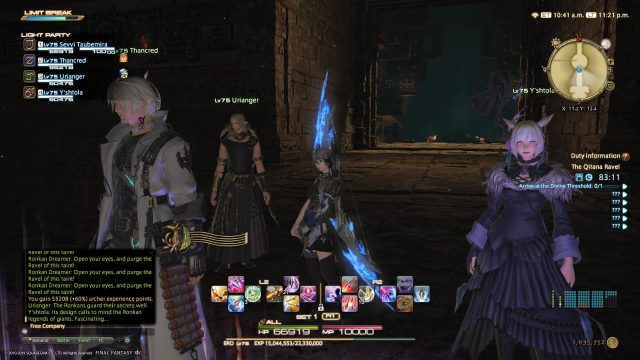
Final Fantasy XIV: Shadowbringers
RPGamer: Do you plan on integrating or adding accessibility options into Final Fantasy XIV such as colorblind options, playing the game one-handed, or other options that appeared in Final Fantasy XVI like the sound waves on the sides for people hard of hearing to help widen your audience?
Naoki Yoshida: Actually, Final Fantasy XVI had those accessibility functions because XIV already had them. In Final Fantasy XIV, we do have the colorblindness settings. There are different settings where you can change the color scheme so that it will help you see better if you have those kinds of challenges looking at the different colors. I believe there are three settings for that.
For the sound, there are sound cues that you can turn on in the configuration as well where you can see the sound waves of the surrounding sounds as well. At least those two functions are already implemented in XIV.
Like I mentioned, the color vision diversity, we do have those three settings, but then we also receive feedback about how we’d like more variations on that, so I would like to discuss with the UI team. The UI team is also very active in their research on how do we make it more accessible for players.
You mentioned about the one-handed controls. I think right now there is a way, you have to kind of figure it out and customize it yourself. But we have the cross-hotbar function, so if you set up your action palette to lean more towards like mostly use your right hand or use your left hand, I think that would help you be able to utilize just one hand for your controls. I have had examples where players would tell me that they were able to get through a raid by customizing their setup. That said, it is a little unclear to get to that, I think. It’s not very obvious, nor is it a preset function that people can just easily kind of set up, so that’s a good question that I should bring back to my team to discuss. It might allow for more opportunities for people who feel kind of intimidated by the different controls to have that available more readily. I’m going to discuss that with my team when they get back.
RPGamer: Has the development of Final Fantasy XVI impacted how you approach anything with the development of XIV, or vice versa?
Naoki Yoshida: I feel like it’s more of the opposite. Let me explain, with Final Fantasy XVI, the platform that it’s on, the specifications to run the game, and the way we can show the graphics of the game is different. For lack of a better word, I feel it’s more advanced technologically, because it’s a standalone game as opposed to an ongoing online game like XIV. The amount of cost and resources that we can put in is different, so are the specs of the hardware or the processing and whatnot for this game. I struggle to find the right word because it’s not necessarily high or low, but for the lack of a better word, it is a little higher in terms of producing XVI.

Final Fantasy XVI
Naoki Yoshida: Of course, with Final Fantasy XVI and XIV, we had different teams working on them. While that they were separate, there were some developers on the XVI team and some of the leads that kind of moved into helping XIV to add to and support where needed. There were a lot of learnings and good points that we have gleaned from the production of XVI, but I wanted to draw a clear line so we don’t want to try to make XIV into XVI, basically, because that causes some of our developers to focus in on a certain point where it might start to look different or it might feel different. Final Fantasy XIV is supposed to be an MMO where we have many people playing at the same time, and every one of them has different views and values. If we start to hone in on just one single aspect, that would topple the balance, so these games are different. I wanted them to understand that we don’t want to kind of focus too much into how do we enhance the technical aspects or the visual aspects, and to be very mindful of it. There may be elements that might have worked with XVI, but might not necessarily work for XIV. So, I think it was a very interesting experience because I had to kind of manage and control what they do bring back into XIV.
Another thing I did notice was that of course, we already have a lot of players worldwide playing Final Fantasy XIV and Final Fantasy XVI. It was a standalone game, and from an MMO perspective a lot of people still say “I haven’t played Final Fantasy XIV because it’s an MMO,” but I see them playing XVI. So I was like, wow. If they see that it’s a Final Fantasy that’s standalone like Final Fantasy XVI, they would try it out. So I felt that there is more opportunity and more space for us to kind of continue reaching for more people to get to know Final Fantasy XIV.
RPGamer would like to thank Naoki Yoshida and his interpreter, Aimi Tokutake, for their time in answering these questions about Final Fantasy XIV and his career as well as Mel Karimzadeh and the Square Enix PR team for making it possible.



Recent Comments