Daemon X Machina: Titanic Scion Review
A Titanic Fumble
Daemon X Machina: Titanic Scion wastes no time in getting the player right into the action, even if it means the player will be confused for much of the opening hours. The game follows a fully voiced and customizable protagonist who is saved by their friend, Nerve, from an experiment by the Sovereign Axiom to turn them into a biological weapon called a Centurion. The Sovereign Axiom is an organization of Outers, an offshoot of humanity enhanced by Femto, a substance with multiple applications throughout the world of Daemon X Machina. Nerve and the player then make their escape from the Garden, an orbital station above a post-apocalyptic, war torn world, with Nerve sacrificing himself to send the player down to the planet below. The player is taken in by the Reclaimers, a rebel group of Humans who oppose the oppression of the Sovereign Axiom. This begins an action-packed adventure of rebellion, twists, turns, anime-style mech fighting, and narrative flourishes, with a story that juggles too many things haphazardly for its own good. It’s a package that fails to meet the quality standards recommended for a premium-price game.
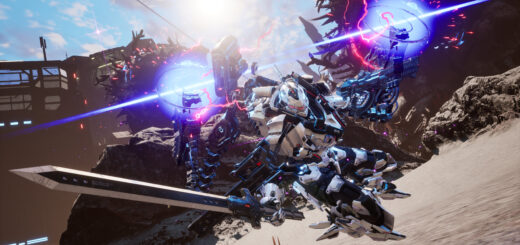
In a bold move, Titanic Scion ditches the larger mechs of the previous game for smaller, human-sized ones that act more like exosuits than vehicular weapons. To the game’s credit, this allows for animations to feel incredibly natural with fun flourishes and details, and enables non-mech characters to utilize unique effects without feeling too small. The combat animation quality for the player is definitely the highlight of the game’s presentation, one that paints a stark contrast to the rest of the game. While the art direction can be interesting at times, the world and characters fit an extremely by-the-numbers anime post-apocalyptic society. But even when the game shows some personality, the visuals themselves are so blocky and low-res that nothing sticks out.
The game is split up into three large areas to explore: a desert, a forest, and a mountain range. Unfortunately, the desert is so devoid of color that more often than not it comes off as garish and uninteresting. The forest and mountain range are somewhat more colorful, but both of them have so much foliage that it becomes difficult to tell them apart visually. Cutscenes also suffer from a lack of fidelity. While the small number of choreographed action scenes are fun, most of the cutscenes involve characters standing around and talking. While not a big sin in and of itself, the animations of the character models leave a lot to be desired, and the jagged, stiff facial animations are the biggest offenders.

A big win is being able to choose between a dog and a cat to inhabit the base.
Gameplay and systems are going to be the sticking point for most in a game of this type, and the bones of the combat are certainly there. Titanic Scion boasts a staggering amount of weapon types and build customization, to the point that players might discover their favorite weapon type later into their playthrough than most would expect. Each weapon type, long or short range, feels unique, and the ability to equip four main weapons, a shoulder weapon, and a throwable grenade allows for immense customization. Swords and other melee weapons offer a satisfying crunch with every hit, while the damage numbers and visual effects of long range weapons do a good job of separating gun types from each other. The only weapon type that feels out of place is bows. Using them snaps the player to an over-the-shoulder view that has to be canceled out of with a button press, and movement in this view is incredibly restrictive. Bows are the only weapon type to do this, which can be disorienting for those who haven’t spent time getting used to it. Shoulder weapons typically require the player to hold down the button until the target is registered before releasing, but a lack of visual feedback on when the conditions for firing are met means it’s far more consistent to equip a shoulder weapon that heals instead.
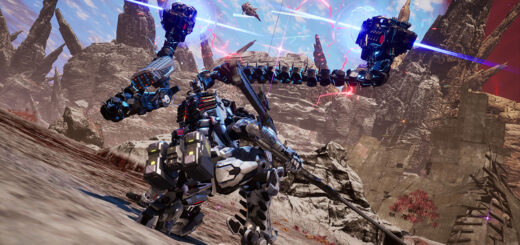
Unfortunately, the game’s movement and camera hold the combat back quite a bit. Movement comes in two flavors: painfully slow or way too fast. Normal walk and float speeds are so slow that it is tempting to use the dash, which will then result in the player completely overshooting their mark, resulting in melee-centric players resorting to using an attack so they can snap to their target. Bigger problems come when some enemies and one particularly annoying boss disappear from view and cannot be locked onto, which also disables the player’s melee weapons snapping on them. The weapon still lunges forward, but without a target it becomes incredibly likely to completely whiff even if the player has every visual indication that they are right next to the enemy. The camera is even a problem with massive targets, as the camera fails to pull out or do anything to accommodate the massive size of the enemy, resulting in close combat being a visual mess most of the time.

This boss specifically caused some camera issues.
Combat and customization aren’t the only elements of Titanic Scion‘s gameplay. The game’s open world structure effectively mandates a large collection of sidequests and activities. Side missions range from standard fetch quests, escort missions, side stories, or even just meeting certain equipment conditions. The game further boasts a coliseum with a ranking system, an in-game trading card game complete with collectible cards, and more. The problem is that the game rarely properly incentivizes actually engaging with these systems, because the main story never guides the player towards these in a meaningful way, so players engaging and enjoying these systems is entirely contingent on whether or not they enjoy the core gameplay and want to experience more.
Unfortunately, the game’s technical state leaves much to be desired. On a base PlayStation 5, stuttering abounds at the most random times, especially when travelling large distances in the open world. Loading times are also extremely long, especially for a game with such poor visual fidelity at times. Worse still is the fact that every time the player loads into an area, they risk being locked in a loading elevator (independent of the actual loading screen) for an extended period of time. While this isn’t exactly an infinite loading glitch, it does kill pacing and turns side content into more of a chore than it should be.
On the topic of the main story, even at the best of times it is still a complete mess. The game’s disappointing presentational quality aside, the actual plot is a collection of interesting ideas and concepts given absolutely no time to be developed properly. Every two missions there seems to be a major twist that theoretically upends the entire story, but none of these twists seem to change the characters’ perspectives or actions much. Major events will happen back-to-back-to-back, but then the player will suddenly be sent on an errand to collect materials to unlock a new combat or gameplay feature, bringing the pacing to a complete halt for no reason. Several instances will occur where characters will mention a concept that was never addressed before, which will leave many just confused because it never gets proper execution or explanation. The narrative also doesn’t seem to have a grasp of its own themes, as it is constantly picking and choosing themes to evoke for certain narrative beats rather than weaving them together naturally. One moment the game will be about oppressors versus the oppressed, the next it will be about what it means to be human, before suddenly veering into a war story, the list goes on. It’s a real shame too, because the ideas presented, while certainly cliche in areas, are interesting. But the execution of these ideas is so poor that the narrative easily becomes the game’s weakest element.

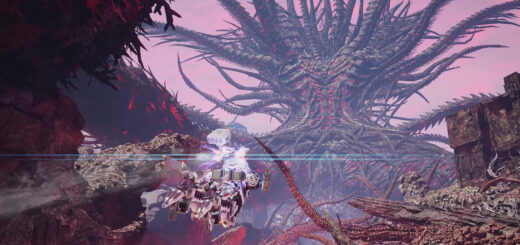
An example of the low visual fidelity not aiding the game’s art direction.
That said, what does shine is the voice acting. Several prominent video game and anime voice actors, such as Damien Haas as Nerve and Mela Lee as Hex, are present and all of them elevate the dialogue into enjoyable campiness rather than just boring word soup. Special mention must go to Paul Castro Jr. for his performance as Ash, who, by all accounts, should be easily the most annoying character in the game by a long shot. He’s constantly berating the player, he’s never shown to be competent, and is just all around a pretty miserable character on paper. Castro Jr. elevates this by going completely overboard on almost every line delivery, transforming Ash from a boring jerk to the angriest, loudest, goofiest character of every scene. While this doesn’t change anything about the story, it does go to highlight that a good performance can go a long way in making a character palatable. The soundtrack is another example of this, as the music does an excellent job of shaping Titanic Scion‘s identity with a metal-infused symphonic sound that is at once familiar and unique. It’s a shame that the soundtrack does feel limited in scope when it comes to enemy encounters, with only a few bosses having memorable, unique themes.
Ultimately, Daemon X Machina: Titantic Scion is difficult to recommend. While the bones of combat and customization are well executed, the open world element feels tacked on to an abysmal main narrative, and technical issues hold the game back even further. While these things are forgivable on their own, the full launch price tag feels extremely steep for such an underbaked game that has paid DLC customization options on top of it. Those who enjoy the mech-fighting genre will certainly find something to enjoy here, but others will find a game that feels incredibly undercooked.
Disclosure: This review is based on a free copy of the game provided by the publisher.


Fun combat
Dense customization features
Spectacular voice performances
Overall poor presentation
Technical issues on current-generation hardware
Frustratingly bad narrative



Such a shame it launched at $70 and on all platforms, none of which ran well. I was hoping the Switch 2 version would be good enough to warrant the physical release, but it’s easily the worst version out there.
Steam sale, here I wait.