Atelier Resleriana: The Red Alchemist & the White Guardian Review
Something Old, Something New
While I’d played the Atelier series only sporadically over the past decades, binging the Atelier Ryza trilogy last year is what fully cemented my love of this long-running series. Atelier Yumia was a fun game to play earlier this year, but it was definitely a unique flavor of Atelier game with its open world and action combat. With Atelier Resleriana: The Red Alchemist & the White Guardian, Gust has returned to its roots with a title that feels like a perfect blend of the older Atelier games with many modern features. The game looks and plays amazing, boasting a heartfelt story, excellent new game mechanics, and an engaging battle system.
The opening of Atelier Resleriana introduces players to dual protagonists Rias Eidreise and Slade Clauslyter. Both share heartbreaking memories of a tragedy that befell their hometown of Hallfein twelve years prior. The entire population disappeared in a sea of red mist, leaving only monsters in their wake. Rias lost her grandfather, who had basically raised her and was a local shop merchant loved by all who visited from miles around. Slade lost his parents, who left behind powerful relics for him, the mysterious Geist Cores. On their first mission together, Rias and Slade discover an abandoned atelier and learn that the Geist Cores can open Dimensional Pathways that lead them through procedurally generated dungeons to lands far from their hometown. In the Dimensional Pathways, the duo encounters tiny flying figures called fairies, which can be recruited to help with multiple game systems described below. With the fairies’ help and a team of alchemists and party members from previous Atelier games, Rias and Slade unravel the truth of what transpired a dozen years prior while rebuilding their hometown in the process.
The story is immediately engaging and fascinating in Atelier Resleriana. Rias and Slade share so many heartfelt scenes throughout the narrative that show they are still deeply affected by the devastating events of their childhood. The impact of what they discuss and hope to accomplish is quite touching, missing only some English voice acting to further amplify the gravitas of their mission. As they work to restore their hometown, now under the governance of Rias’s sister, Camilla, they are joined by various alchemists and party members from previous Atelier games. These characters, all called Wanderers, have stumbled through convenient plot points to appear in Rias’s world. Some join the party as playable characters, while most simply stay in town and provide side quests and support via Star Landing, the home of the Hallfein Restoration Project. The story plays out in a breezy adventure of less than 40 hours, and while the ending is satisfying enough, there are definitely doors left open for this game to have a sequel or two, a habit Gust has recently adopted with the Ryza trilogy and Sophie 2.

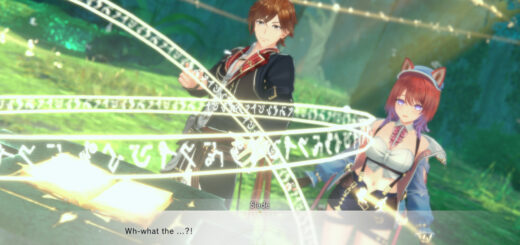
Is it time to rest, or is there no time to rest? So confusing!
Gust went to full action combat in Atelier Yumia after skirting the action-turn-based line in the Ryza trilogy; however, Atelier fully returns to its roots in Resleriana with a completely turn-based battle system. There is a fun bit of flair in the ability to hold a button to partially block attacks, with more precise blocking greatly reducing the damage taken. For players who do not wish to engage with this feature, they can turn on auto-blocking via the game’s menu, though precise blocking will not be available. As the party grows in Atelier Resleriana, multiple excellent battle features open up, making the combat so much more than just another turn-based system. Each turn, players can choose for the characters to use powerful alchemy items, do a standard attack, or expend TP to use a skill. Everything has one of seven elemental or physical properties to it and enemies can be strong against, weak to, or neutral to them. Turn order is clearly shown to the right of the combat screen, and various random buffs and debuffs can be seen coming there as well. Players can use interrupt commands and the Unity system to affect turn order, ensuring their party receives the buffs and enemies receive the debuffs.
The Unity system is where the battle system in the game truly shines. All attacks charge the Unity gauge, and players can choose to expend part of that gauge to perform multiple attacks. For the most part, this simply allows players to take multiple turns at once, with either two or three characters attacking simultaneously. The real magic occurs, though, when players find the right combination of skills or items that trigger additional effects. Item Mix is activated when specific complementary or paired items are used in order. Ice and lightning bombs used one after another might not only both hit but also cause an additional powerful attack that can easily double the total damage of each bomb. Similarly, player skills such as a wind tornado and fireball might ignite a third fire tornado after the individual skills hit, which does massive damage. A great deal of fun can be had by playing around with placing party members in the front or back line to manipulate when Unity attacks become available. Once players learn what works well, even some higher-level overworld encounters can be finished in a single well-planned combat turn. The stunning, bright visuals of the battle system only highlight the satisfaction of pulling off these attacks, and while the battle animations might seem to drag for some players, battle speed can be increased rapidly at the touch of a button.

The battle system has multiple great features and just looks spectacular.
To pair with an excellent battle system, the alchemy mechanics in Atelier Resleriana are another standout feature. Alchemy in this game is all based on matching colors. Every item in the game has a left and right attribute color. Ingredients also convey special traits to items formed during alchemy, such as increased attack power, better defense, or increased lightning damage, for example. Each time a player creates an item via alchemy, they proceed through two phases of mixing. The initial phase requires players to place three to four materials together. Without those first ingredients, items cannot be formed. Linking colors in this phase can imbue stat-boosting traits and raise the level of the item. The second phase of alchemy is virtually identical but completely optional. Color linking in this phase can not only increase the item count for materials or the number of uses for combat items, but can also imbue more traits. Caution is warranted at this point because only the three most recently added traits will remain, with older traits being overwritten. Players who do not wish to remove powerful traits can choose not to link colors, or they can try to match similar traits together to imbue more powerful combined traits.
The second phase of alchemy is also where players can unlock new recipes. Each item has a progression tree, and when certain materials are obtained, players can see what needs to be added to their base item to morph it into something new. For example, adding in a specific ice item during the creation of a bomb will change it into a more powerful ice bomb as long as the colors between the ingredients are all matched. If this all sounds like a lot, it is, but the game rolls out all these systems slowly throughout the game. The alchemy systems are wonderfully paced, so that just as players become more confident engaging with what’s available, something new opens up. Players eventually unlock the ability to clone items they have and enhance items they’ve created with the help of both fairies’ and party members’ skills. A great deal of money is required to use these alchemy shortcuts, though, but that can be obtained through one of the two new gameplay features Atelier Resleriana offers.

Color-matching ingredients while performing alchemy enhances items’ effects and imbues customizable traits.
Central to the plot of Atelier Resleriana is the restoration of Hallfein. Rias’s sister, Camilla, is in charge of the effort, which requires a great deal of money for improvements, along with the collection of plenty of items created via alchemy. The five districts of the city can be leveled individually by speaking with Camilla. The upgrades not only change the appearance of the town but also allow merchants in each area to offer more supplies or even books of alchemy recipes. To afford both the valuable books and the improvements themselves, Rias has inherited her grandfather’s store. At the shop, Rias can sell up to nine items in each cycle. Items are placed on a bookcase, and similar to the alchemy system, matching colors offers benefits when selling. Rias can sell collected ingredients for small amounts of money or items created through alchemy for much more. In fact, once item duplication opens up, a great number of created items sell for far more than they cost to create. Large amounts of funds can be had by finding such items, lining them up appropriately on the sales shelves, and then letting the right fairies manage the shop. After a couple of sales rounds, though, the fairies grow tired, and it is time for Rias and her party to venture out and continue their adventure, leaving the fairies time to recharge.
If this was all the game offered, it would still be a well-rounded Atelier offering. A key aspect of many games in the series is building relationships with NPCs around town, and this game has plenty of that! There are dozens of people for Rias and Slade to interact with, and hours of fun can be had listening to them share their hopes, dreams, and worries about the town and the wider world. Wandering alchemists and characters from past Atelier games are passing through Hallfein, and it’s well worth a player’s time to get to know them and accept their side quest requests. Once players complete a quest or two from them, these characters can be recruited to gather rare alchemic materials not obtainable in any other way. These characters will also point the party to strong monster encounters. Defeating those monsters in turn increases their friendship level and allows them to find even more rare items. It’s an enjoyable side quest loop that runs in parallel to the normal gameplay loop and allows for the creation of some of the best items and equipment in the game. While this gameplay element is not entirely necessary to engage with, it is highly recommended that players do so.

The interior of Rias’s atelier is one of most visually stunning ones in the series.
Atelier Resleriana not only looks amazing but also uses its visuals to beautifully mirror the progression of the main plot. The magical Dimensional Pathways have an ethereal charm, while the overworld sections look exactly as one would expect fields, forests, mines, and volcanic regions to look. The town of Hallfein, however, is where the game’s visuals truly shine. At the start, the town looks sparsely populated and mostly abandoned, with bare gray stone exteriors and little decor. As the story progresses and players complete restoration goals, the city undergoes a fantastic transformation. By the end of the narrative, colorful lights and banners are strung around town, and signs of habitation and splashes of color can be seen all around. Along with the wonderfully animated familiar monsters and the large number of carefully crafted series characters, everything looks so alive and vividly colored. Kudos to the development team for including text size options as well as a color filter setting to accommodate those with differing visual needs. Likewise, there are plenty of audio settings for players to spend time customizing. Players can create their own in-game playlists for each location so the same song doesn’t loop continuously. There are many excellent tracks to explore, and setting a playlist of personal favorites is a fun way to hear the best ones more frequently. The final boss theme, for example, doesn’t have to be experienced only once.
Finally, a few other things about Atelier Resleriana are worth noting. While the game is most often well balanced in its gameplay loop, there were a couple of times where progression ground to a halt when specific treasure chests hadn’t been opened to provide alchemy recipes needed to advance the town levels. Locking progression behind out-of-the-way, corner-of-the-map exploration wasn’t ideal, but at least everything was clearly visible on the provided mini-maps. As stated before, many alchemists and characters from previous games appear in this title. It is not at all necessary to have experienced their previous games to enjoy their presence. They are all here to support Rias, and anything they bring up is either just flavor text callbacks or is directly related to the central plot. New players won’t be missing out on anything except a bit of nostalgia. Additionally, this Switch version of the game was tested on both the OLED Switch model and a Switch 2. The game played excellently on both, with really only two understandable, noticeable differences: load times between areas were faster on the Switch 2, and some slight slowdown was noted on the OLED during intense sped-up battle animations. Other than that, performance was nearly identical.
If it isn’t already clear enough by this point, Atelier Resleria is an excellent RPG. From battle system to alchemy to multiple other subsystems, everything seemed superbly planned and polished. No previous experience with the Atelier series is necessary to enjoy all this game has to offer, but returning fans will receive plenty of nostalgic dopamine hits. This is a game that shows how a familiar series can be both welcoming to newcomers and deeply rewarding for long-time fans. The developers have successfully crafted a title that honors its legacy while forging a new, promising path forward.
Disclosure: This review is based on a free copy of the game provided by the publisher.

Excellent turn-based battles with timing elements and adjustable turn order
Beautiful visuals, particularly the town's transformation and the atelier interior
A well-paced and wonderfully implemented alchemy system
Excellent accessibility options with various text sizes, color filter, and audio settings
Offers a rewarding side quest loop for character relationships and rare items
No English voice acting to contextualize a very emotional story
Town improvements tied to hyper-specific recipes slowed progression occasionally





Recent Comments