Arco Review
Fighting Back on the Frontiers
Panic’s Arco brings plenty of fresh ideas and inspirations to the gaming sphere. With its fantasy take on the American frontier drawing inspiration from Mesoamerican cultures and “Newcomer” expansion providing a distinct setting, while a fascinating blending of turn-based elements with simultaneous actions gives players a welcomely different experience that enriches the tactical sub-genre. Its tale of revenge is decently paced and doesn’t run too long, meaning that despite some unfortunate technical issues, it’s easy to overlook them in favour of what the game does well.
Arco’s tale is split across five acts. The introduction chapter follows young boy Teco from a tribe in the arid North American-inspired region the game is set in, eventually running afoul of the Newcomers looking to expand into a frontier of promised riches. It then moves into three arcs, following their own main characters as they go about missions. All of these journeys congregate into the same place and the same revenge-driven goal ahead of the final arc where the story meets its conclusion.

While inspired by the American frontier, Arco’s world has its own unique elements.
The game does a good job steadily building up its setting, although it never delves too much into the intricacies of things. Each of its protagonists being from different tribes allows players to get varying viewpoints, and the setting distinguishes itself with plenty of design choices that enhance these viewpoints. It’s still a by and large very straightforward tale of revenge with the obvious destruction that frontier attitudes and greed have wrought, without any real unexpected twists and turns, but the game is effective in getting emotions across.
Players move from place to place on a map of connected nodes, following a main quest and completing several optional quests and encounters should they wish. Each node offers a small explorable area, such as a village, small field, object of interest, and more. Each area usually contains at least one combat encounter, place to trade, quest assignment, or other event, as well as some harvestable items. Many encounters can have different resolutions that players can reach based on choices, including potentially bypassing conflict, while others have choices that result in an advantage, or indeed disadvantage, in the inevitable combat. It offers a good amount of engagement and helps develop the setting, but the choices are finite and the events are quick enough that many players can easily just reload and see what brings the best result.
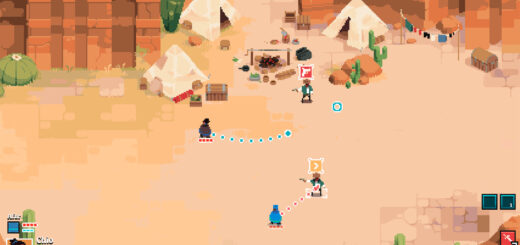
Arco’s combat is where the game truly stands out. The game features a turn-based, gridless tactical system, but the actions of each turn play out simultaneously. Players have between one and three characters to control, usually facing off against multiple enemies that come in waves. Fortunately, players are informed about what the enemy’s action will be ahead of the turn, and so the strategy comes from planning accordingly based on what the enemy is doing. Hit points are at a premium in the game, especially when firearms can see a character losing all their health in a single turn, so it really behooves players to avoid strikes as much as possible while waiting for an opening.

The simultaneous turn-based combat requires a lot of concentration and will swiftly punish mistakes.
Each turn permits a single action including movement, though some special abilities are free to use with an accompanying cooldown, while all melee attacks incorporate movement as part of them. However, each action also requires a certain amount of magia to be performed, with the exception of moving, which grants one magia, and waiting still, which grants three. There’s a great deal to consider when making a move to attack, such as when projectile weapons will reach their target, where an enemy might be moving to, the speed difference between melee and ranged attacks, and more. If that wasn’t enough, the game also throws in ghost enemies that effectively represent the character’s inner demons and guilt. These are not bound by turns and will move towards players while they are plotting their move, dealing damage if they come into contact, but can be attacked to remove the danger. Certain battlefields provide additional environmental dangers, and some sometimes bonuses.
Ultimately, the combat is highly effective, helped by the encounter designs that ensure every battle requires players to pay attention and develop strategies to take into account both the player and their foes’ abilities. The game comes with a lot of challenge, which makes getting through an encounter with minimal health loss incredibly satisfying. With that territory, however, comes plenty of frustration as small mistakes can lead to failure, and there are a number of very challenging fights in the game. Saying that, most of the toughest encounters appear to be fully optional, and failure is met with the option to immediately retry and access any menus beforehand.

Event scenes offer a mixture of quest-impacting choices and potential trade-offs for advantages.
Arco’s growth system is closely intertwined with the combat. Each encounter grants experience, which can be found on each character’s skill tree to purchase upgrades. Some of these are passive bonuses, adding health or magia, but most grant new skills that can be equipped to that character to use in combat. Despite the small number of playable characters, there’s a decent array of abilities to choose from and can generate a good selection of different strategies from the abilities they equip.
Arco’s distinctiveness is further enhanced by its lo-fi pixel graphics, although it comes at the cost of the individual character and location designs being largely unremarkable as they just don’t have the details to stick in the memory. The music is largely good, highlighted by the Spanish songs that punctuate the end of each act. However, the presentation is hampered by the game’s biggest caveat at launch: technical difficulties. The game crashes to an error message quite frequently on Switch, while some of the more involved and longer battles — especially those with numerous projectiles flying around — caused major slowdowns to both the graphics and audio. The game’s very frequent autosave, plus the relatively short duration of battles, at least mitigate the issue where in another game it could be a major dealbreaker. A patch is imminent that may well address most of these issues.
While not without its weaknesses, Arco is thoroughly welcome addition to this year’s slate of releases. The game’s setting does a fine job bringing in an underutilised inspiration and putting its own stamp on it, while the gameplay offers something refreshingly different. As an enjoyably condensed package, it’s well worth the time.
Disclosure: This review is based on a free copy of the game provided by the publisher.


Lots of neat ideas
Makes good use of its American-inspired setting
Frequent crashes and other technical issues
Small room for error can be frustrating




Recent Comments