Hellforged Interview
Video games continue to innovate and refine their titles. No matter what subgenre is being adjusted, it feels like there are titles tweaking the known systems into something exciting and unknown. This is true for the recently popular bullet heaven or horde-survivor genre, and Moonpyre’s Hellforged looks to take that established gameplay and add in the wrinkle of loot collection and extraction. Joining RPGamer today to talk about the current public playtest and the future of Hellforged are Moonpyre’s Founder/Game Designer/Programmer Lukas Tomondy as well as Tadeas Jan Michalov from the QA/Design team. Hellforged is in a public playtest right now through Steam.
Ryan Costa (RPGamer): Mixing a horde-survivor with a loot system of a hack-and-slash action RPG does not sound easy. Have there been any unexpected hiccups during the playtest period that the team has had to adapt to?
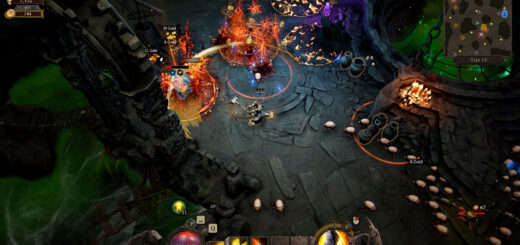
Moonpyre: One of the main hiccups was how traits scaled with gear stats. Both could look reasonable in isolation, but playtest footage and screenshots revealed combinations that were far more powerful than we had anticipated. Some of these combinations created complete mayhem on the screen, sometimes to the point where combat became difficult to read or encounters lost their challenge.
Our goal was to make gear stats feel meaningful rather than giving players small bonuses they would barely notice. However, certain stats need to be treated differently. Evade Chance is a good example, as it can quickly get out of control once it rises above 30%, especially when combined with other stats such as Energy Shield. Finding the right balance between letting players feel overpowered and maintaining challenge and visual clarity is still an ongoing process, particularly with stats that are this sensitive.
Another big challenge was finding the right balance between player choice and randomness. In a traditional action RPG, players often choose a handful of abilities and use the same build repeatedly. That would make runs in a horde survivor feel too predictable, so we created the Arsenal system currently available in the game. It gives players some control over their build while still presenting different abilities and powers throughout each run.
We also had to introduce the depth of an action RPG without overwhelming players who are used to a simpler horde-survivor experience. Instead of unlocking every system at once, new mechanics are introduced gradually through a progression journey. This gives players time to learn each layer before the next one is added.
RPGamer: With loot being a major part of Hellforged, how difficult has it been to balance drop rates?
Moonpyre: Balancing loot drop rates has been one of the more challenging parts of development because loot needs to feel rewarding without overwhelming the player.
At first, the drop rates were overtuned, and players were extracting with far too much loot. Our private playtesting group helped us identify the problem and move the system in the right direction.
We made several adjustments across multiple patches, and while the balance is still not perfect, it is much better than it used to be. We do not want to give players so many items in a single run that the game turns into a loot-management simulator. At the same time, we do not want players to spend 30 minutes in a run only to extract with five items.
Finding the right balance between rewarding the player and preserving the value of each item is an ongoing process, so drop rates may continue to change in the near future.
RPGamer: How many classes will be in the final version? How different will their skill trees end up?
Moonpyre: We’re currently aiming for three or four playable heroes for Early Access, with more details to be revealed later.
Each hero will have a unique main attack, Overcharge ability, passive trait, and a small hero-specific upgrade tree. These differences will encourage players to prioritize different stats, relics, and playstyles. The broader progression systems will remain shared, however, as the game already offers a great deal of depth without giving every hero a completely separate skill tree.

RPGamer: Will there be any objectives or chances for greater loot that are tied to staying longer in the rifts that add to the risk/reward system, or is everything drop rate-based?
Moonpyre: We want risk and reward to come from taking on harder challenges, rather than simply spending more time inside a run. We’re planning unique items with handcrafted powers, stats, names, and visuals, although we are still deciding whether they will come from rifts, specific bosses, or other challenges.
We also want gear refinement to happen during a run instead of safely at camp. Players will need to complete a difficult objective within the map to earn the opportunity to improve an item’s affixes. This should make upgrading gear feel like a reward for taking a real risk.
RPGamer: Based on the playtest, it felt like a longer-than-typical time to get projectile attacks as compared to other titles in the genre. Is this melee approach by design or just a byproduct of being in the early game?
Moonpyre: The melee-focused opening is intentional. The first Ability Shrine appears ~45 seconds into a run, and until then, players must rely on their basic attacks. We want that opening to create pressure and make the first ability feel like a meaningful power spike. Once players gain it, they should feel more confident and powerful, and that is where the real build scaling begins.
The shrine does not force players to claim the ability immediately. Once it appears, they can choose when to summon and fight the enemy that grants it. More confident players can take on that challenge immediately, while others can wait until they feel ready. So the delay is less about restricting projectile attacks and more about creating a deliberate sense of progression at the beginning of each run.
RPGamer: With the skill tree that expansive, will there be the possibility to max everything out with enough experience, or are there limits to how far down each path a character can go?
Moonpyre: Players will not be able to unlock the entire skill tree. Each hero currently has a maximum of 30 points, which keeps progression achievable without requiring hundreds of hours of grinding.
Because the tree contains more nodes than a player can select, every build requires meaningful choices. Instead of eventually unlocking everything and forgetting about the tree, players can experiment with different strategies, builds, and presets depending on how they want to play.

RPGamer: Will there be exclusive gear that only certain characters can use?
Moonpyre: We haven’t made a final decision on hero-exclusive gear yet. If we introduce it, it will most likely be through special unique items designed specifically around a particular hero’s abilities and playstyle.
RPGamer: The Steam page mentions heists. Is this due to the feeling of trying to get one more piece of equipment, or will this term fit into a gameplay mode or two down the road?
Moonpyre: “Heists” is a figure of speech rather than a separate game mode. Finding valuable loot is only the first step, you still need to survive and secure it by escaping through an exit portal or completing the run and reaching the obelisk. Until then, the loot is still at risk.
RPGamer: The Undercrypt map, where players go adventuring, seems to shuffle around on each visit. What are the biggest benefits for the replayability in the team’s mind to having a procedural generated map?
Moonpyre: The shifting layout of the Undercrypt is intentional and one of Hellforged’s biggest differences from other horde survivors. Spawn positions change between runs, and we plan to offer multiple handcrafted variants of each map, so returning to the Undercrypt will not always mean seeing the same environment.
Fully procedural maps can offer variety, but they often sacrifice visual quality, pacing, and memorable details. Our approach allows artists to carefully place rewards, destructible props, and environmental storytelling while still making each run feel different.

RPGamer: Right now, it feels as though players gain a bit of a reprieve with a few pieces of loot able to be kept even if they lose a run. Will this change with higher difficulties or the full version of Hellforged?
Moonpyre: Secure slots were added in response to playtesting. For new players, losing everything after a few failed runs could make their time feel wasted and discourage them before they had a chance to learn the game.
We plan to keep secure slots so players can always save a few important items, while the rest of their loot remains at risk. We are also considering backpacks that expand this capacity slightly, as well as optional difficulty modifiers that remove secure slots in exchange for better rewards. This lets players choose how much risk they want to take.
RPGamer: What is something that you would love to share about the game not discussed above?
Moonpyre: Many of us are passionate World of Warcraft players, so its sense of adventure and discovery has naturally influenced us. At the same time, we want Hellforged to have a clear identity of its own, from its characters and interface to its world and gameplay.
The current setting is only one part of a much larger universe. Players join an expedition that has crossed through a portal into a hostile, unknown world filled with new creatures, potential allies, and dangerous enemies. We want to expand that lore over time through new zones, stories, content, and potentially new ways to play.
The developers are hard at work on Hellforged to make it a thoughtful and addictive horde-survivor action RPG. With the playtest only growing and more information, gameplay, and builds on the horizon to keep an eye on. Thank you to Founder Lukas Tomondy and Designer Tadeas Jan Michalov of Moonpyre and Matt Greloch, PR Manager of Grindstone Games, for making it all happen. Take a look at the public playtest for Hellforged on Steam.




Recent Comments