Astria Ascending Deep Look
Astria Ascending is a game that’s simultaneously going deep and staying shallow, where the developers had a grand vision but poor follow-through.
I don’t regularly do direct shopping on the Nintendo eStore, but it has happened enough for me to accumulate a fair amount of spare change and store points. With that, I might pick up an item or three at a severe discount, just to see what’s out there. That’s how I ended up with Astria Ascending on my Switch. Once I realized that I’d actually played some of its antecedent game at a Tokyo Games Show event a decade ago, and that the project came with the collective efforts of several Square Enix veterans, it was an easy choice to make it my first game for #JRPGJuly this year.
As you can see, this is not a review. It’s a Deep Look detailing why exactly I am not going to finish this game. Suffice to say, things did not turn out well in the long run.
That’s not to say that the story and setting of Astria Ascending begins badly. In fact, it all starts out rather promising. The world of Orcanon, once torn and ruined by war, is governed from the City of Harmonia, the capital and shining example to a confederation of disparate races. From its orchards come the harmelon, the fruits of peace, and folk of all sorts walk its streets. At the center, in her ivory tower, the Living Goddess acts as an intercessor between mortals and the divine arbiters of the stars. Serving as her champions are the Demigods, a band of chosen mortal warriors gifted with the powers of the Zodiac but limited to a three-year term before they ascend to join the stars in heaven. It is three months to the end of term for the 333rd band of Demigods, and the millennial hegemony of Harmony is threatened more than ever before by the chaotic Noises (monsters) invading settled lands.

It’s a good setup; a portrayal of a functional utopia with the cracks showing. Despite nearly a thousand years of getting along, the various races of Orcanon still suffer age-old prejudices and dissatisfaction, which certain unscrupulous agents of Discord are happy to capitalize upon. However, having everything occur in the last three months of a three-year tour of duty makes the plot feel crammed in, and it’s odd that none of the Demigods know the least bit about each other’s pasts prior to having it spelled out after those pasts come back to bite them. Some heroes have better lead-ins than others, but I honestly thought one in particular was superfluous for both plot and combat, right up to the mid-point of the game’s narrative when his background suddenly becomes of minor relevance. In any case, Astria Ascending has a decent plot, but the pacing is off, the characters are not done justice in their introductions, and more could have been done with it overall.
That’s a common complaint about much of the game, actually. There are many interesting things about Astria Ascending, but more could have been done with each. The environments are all presented in side-scrolling view, with some elements of platforming, but the level designs are lackluster. There’s some jumping, as well as the occasional puzzle to solve, but more would have been welcome. The player receives a magic ring early on with a panoply of elemental powers to find, but aside from the Light power, which can be used to stun enemy sprites in the field, these see little use beyond the area in which they are found. Instead of gating off areas of the map behind challenges related to ring powers, for example, the player is blocked by NPCs who simply say that no one can go that direction.

Combat has some interesting thoughts put into it, especially in regards to the elemental weakness system. In the upper corners of the screen during battle, there are gauges which fill as the allies or enemies strike at weaknesses in the other side. Hitting a weakness earns two points, but hitting a resistance or immunity incurs penalties, possibly even pushing into the negative numbers. These points can be added to any attack or healing ability to increase the potency, up to +200%. Points are also used to fuel the Astrae, summoned eidolons of plot importance. Figuring out the best combination of party members to hit a major enemy’s weaknesses becomes a key tactic of the game.
The problem lies in the systems supporting the combat. For example, there is no way of being sure of a weakness by looking at an enemy. While monsters are often obvious about what elements they use to attack, that does not translate to showing their weakness to the opposing element, and there is no form of notation or other clue given even if weaknesses have been previously ascertained. Moreover, there are frequently sets of similar-looking enemies in a level that have different weak points. The player is thus beholden to the few skills which allow one to check an enemy’s weakness in the middle of a fight, plus their own memory or out-of-game notes. It should also be mentioned that all bosses are immune to scanning, which defeats the purpose of having that ability available in the first place. There is also a set of abilities specific to a particular sub-class that allows one to impart temporary weaknesses to enemies but, with very few exceptions, practically every monster in the game is also immune to that status ailment. In short, the two most important support systems this battle system could have are either hobbled or ineffective.
As for the skills list, it’s a mixed bag in terms of figuring out what to do with everything. For some reason, half of the elemental spells are named quite obviously (i.e. Fire, Water, Ice, Aero), and the other half are complete fantasy vocabulary (Talar, Nix, Erio, Umbre). The combat menus at least have explanatory windows to let the player know the actual elements for each, but it takes getting used to. However, for the summoned Astrae, the explanatory windows fail to mention what elements they may be connected to, leaving the player to again take extra notes so as not to forget which eidolon does what.

Another issue that’s generally present but which ramps up precipitously past the game’s mid-point is combat difficulty bloat. On top of having to figure out, often from square one, what a new enemy’s weaknesses are, the health totals increase at a faster rate than the party’s ability to level up. This is painfully obvious with the bosses in new areas once the greater part of the map is opened up for free exploration, as they’re all multi-form behemoths with six-figure HP totals and higher-tier magics. Also worth mentioning are the Hunt side quests, most of which are available far earlier than is advisable.
The party is reliant on a skills map, modeled after in-universe constellations with stars for loci, and the player’s own sense of where to allocate skill points, but the rate at which skill points are earned never increases to match the growing difficulty. For regular battles, the reward tends to be one SP for every enemy to enter battle, making the rat mobs in the very first dungeon some of the best in terms of grinding. Each character has a base skill map, plus eventual options for a secondary class with extra skills and two supplemental classes for stat gains. This adds up to a lot of SP needed to fill things out, a low trickle of SP gains to fill it with, and frequent choices between necessary stat gains and necessary class skills. It’s a situation destined to turn the game into a case of grind per se grind, in a combat system growing increasingly stale as the same fights are repeated. Due to the degree of player choice in character classes and stat gains (with many stat loci featuring a choice of which stat to increase), it’s also possible to screw up a build by accident.
There are plenty of other, minor things to talk about, like the palpable lag on the menu cursors, the lack of names on dialogue bubbles that don’t quite point to the speaker, or the weirdly tacked-on tile game that was inspired by Triple Triad, but it all leads to the same mess in the end. Astria Ascending is a game that’s simultaneously going deep and staying shallow, where the developers had a grand vision but poor follow-through. I’ll say that it did have me going in the first half, though I wouldn’t have considered it anything more than moderately average in execution. The way things went in the second half, however, sent my estimation of the game plunging far deeper than the plot would ever follow. And so, with that said, I am officially washing my hands of this one and moving on to other titles.

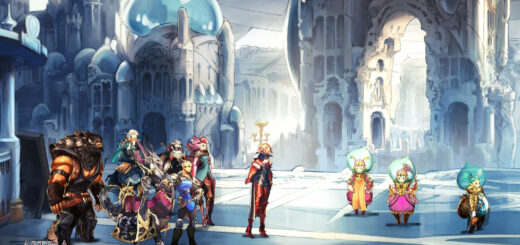




I’m rarely disappointed by a title but Astria Ascending is one of the few. Wonderful world building, wonderfully detailed locations and sprites but it seems as though 94% of the effort was done on artwork. The combat was an obnoxious chore by 1/4th of the way through and I dreaded another area filled with slow, ponderous, turn-taking filled with spongy enemies. I disliked half of the main characters as nearly every one seemed poorly written and their “tragic backstories” were not gripping nor interesting. The most grievous error was how the ending was handled. I’ll not spoil anything for anyone that still wants to play or finish the game but it calls in to question everything that was set up in the lore and seems like an enormous plot hole. I was initially impressed and having a good time but 3/4ths of the game was suffered through to justify the day-one purchase.
Let’s say, “This was a good beta and I played a working copy through, now finish the game by making combat more fun and clean up the story to make it more coherent.”