Class of Heroes 3 Remaster Deep Look
Nearly every interesting gameplay element is offset by frustrating implementation, begging the question as to what was “remastered” and what was left from the original release.
The Class of Heroes trilogy was released annually in Japan from 2008-2010. While the first two titles were brought overseas relatively soon afterwards, the third title was never localized outside Japan. After a fifteen-year wait, the classic Japanese dungeon crawler Class of Heroes 3 has now finally made its way to Western shores in the form of a remaster. Class of Heroes 3 Remaster is a fascinating case study of its genre, serving as both a nostalgic blast from the past for dedicated fans and a firm warning for modern players of what old-school DRPGs are like. A deep and rewarding core is unfortunately hampered by a punishing difficulty curve and other outdated elements that may be difficult for many to look past. For those with a love of classic DRPGs, the game might offer some enjoyment; for everyone else, it is a demanding experience that is hard to recommend.
The game’s narrative takes place in a school setting, where players are tasked with creating a party of adventurers to take on dungeons. Early on, the game presents a choice of three different schools to attend. While the flavor text suggests this is an aesthetic choice, it surprisingly alters a player’s starting region, available teachers, and quests. This inventive approach to its opening is an interesting feature that could perhaps prompt fans into multiple playthroughs. However, a lot of the plot points that follow are contrived and boring, often relying on cheap anime tropes like a teacher who speaks in innuendo. The story is clearly not the main focus, as the game’s sole purpose is to send players into the dungeons to grind, fight monsters, and collect loot.

Players are offered three schools to enroll in at the start of the game.
One of the game’s few strengths is its interesting character creation and customization. Players can create a party from a wide variety of fantasy races, including classics like elves and dwarves, as well as unique options such as the cat-like Felpurr and the celestial Diaboro. The class system is even more expansive, boasting 45 different options, including bizarre choices like the Otaku or Tsundere classes. The possibilities for party composition are nearly endless. A refreshing feature is the ability to swap a character’s class at any point, which allows effortless experimentation with new skills and abilities. This removes the penalty often associated with picking the wrong class and encourages players to explore new roles. The problem is that it ends up offering far too much choice and makes it difficult for newcomers to pick a balanced party, with certain classes being very tricky to use. For example, sages start with very little HP and never deal even a tiny fraction of the damage compared to other party members, while also failing to heal effectively. The same can be said for heavy magic user classes, which are ineffective during the first dozen hours of play, and begs the question of how many have been added to pad the options rather than considered gameplay benefits.
Class of Heroes 3 Remaster features another system that initially seemed interesting but inevitably falls flat. The relationship chart system adds to the deep party customization, letting players create a web of attraction and repulsion between party members. These relationships, which have no bearing on the story, provide in-battle synergy and buffs, adding another layer of depth for min-maxing players willing to put in the effort to figure out how it all works. However, the in-game explanations for this system doesn’t help much, and nearly a dozen hours into the game the buffs are rarely of any benefit in battle. That said, party members being repulsed by each other at least causes few problems.

Outside HP/MP, leveling up provides only paltry stat boosts.
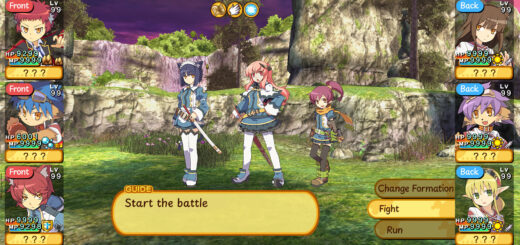
The turn-based battle system of Class of Heroes 3 Remaster is where some players might hope that the deep customization truly pays off, forcing strategic engagement from the very first dungeon. Combat occurs in the first-person view common to the DRPG genre, where a player commands a party of six characters, arranged in a front and back row. This positioning is critical, as back-row units are typically limited to long-range attacks and support spells, while the front line absorbs the bulk of physical damage. Sadly, throughout the dozen or so hours played, the back line’s long-range attacks and offensive magic proved completely useless. Damage from front-line attackers can be 10-20 times greater, leaving the back line healers as the only worthwhile contributors. The promise of so many customizable party options is nothing more than an empty gesture, with only a few specialized builds truly viable for surviving the brutal early battles.
“Brutal” is truly the only way to describe the opening of Class of Heroes 3 Remaster. After nearly an hour spent customizing characters and exploring menus and settings before the first dungeon, the first battle still provided a party wipe after only two rounds, losing all progress. Despite great care in selecting more traditional RPG archetypes — minus offensive magicians — the second time around, and saving much more frequently, the difficulty never lets up. Players’ parties of six can encounter monster groups of up to fifteen enemies arranged in a maximum of three rows of five. There is no pattern of difficulty in encounter or number of enemies; first-floor encounters can contain as many as fifteen difficult monsters, while delving multiple maps deep may produce multiple, simple single-enemy battles in a row.
Players’ survival hinges almost entirely on finding decent weapons and armor, yet the systems for doing so are needlessly opaque. A paltry selection of expensive gear is available in school stores, though gold hard to come by, but the most significant path to power — the Alchemy System — is delivered with minimal explanation, forcing the player to experiment with crafting formulas that are poorly documented, if at all. This lack of instruction transforms a core element of progression into a frustrating trial-and-error grind, leaving the party reliant on random, inconsistent drops from dungeons rather than strategic use of the hub’s facilities. Treasure chests are frequently left by monsters after a battle, but woe to the player that opens every one, as most are booby trapped in some fashion and can inflict crippling status effects on party members that further increase the difficulty.

Learning about the relationship system is at least interesting.
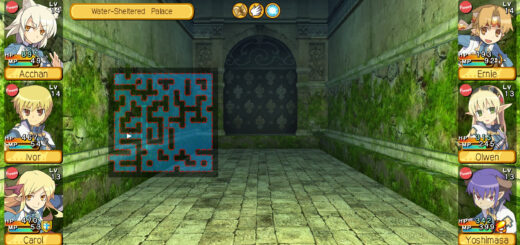
The visual presentation is serviceable, retaining a clean, classic feel that honors the game’s handheld origins, though it lacks the polish expected of a modern remaster. Dungeon exploration and the 3D environments are competent, but the overall graphical fidelity is distinctly dated, giving the game a budget appearance. Musically, the soundtrack is fine; it provides appropriate background themes, yet none of the melodies are particularly memorable. Ultimately, both the graphics and sound design deliver a functional experience that gets the job done without ever managing to impress.
Given the relentless difficulty and the frustrating lack of polish across every core system, the ultimate fate of this long-awaited title is disappointing. The deep class and customization features remain tantalizing, yet the erratic balance, useless back-row positions, and opaque alchemy system constantly undermine the game’s potential. Nearly every interesting gameplay element is offset by frustrating implementation, begging the question as to what was “remastered” and what was left from the original release. Ultimately, the remaster label seems to apply mostly to the translation, leaving players with a game that feels less like a tribute to a classic and more like a time capsule of the genre’s most punishing and archaic tendencies.
Disclosure: This article is based on a copy of the game provided by the publisher.




Recent Comments